




Advertisement.
The Town of Hay River ramped up for another flood and fire season with a public briefing on Tuesday.
Firesmarting upgrades, better communication, more preparation to host evacuees and new equipment were among topics covered by a range of officials.
Questions from residents included concerns about how vulnerable people are supported through emergencies and how people are kept informed in a crisis.
In the immediate future, Hay River’s mayor said record-low water levels in the South Slave mean flooding may not be the imminent threat it has been in other years.
Advertisement.
Advertisement.
“Driving up yesterday, driving home from vacation – there is no water,” Mayor Kandis Jameson said, characterizing the environment south of the town.
“I don’t think we’re going to have to worry about that but, knock on wood, we will be prepared should we have to.”
Town fire chief Travis Wright said Hay River definitely has “more room in the basin than usual” given the low water levels, but the unpredictability of ice jams – where ice dams the river and pushes water over the banks – means the risk still isn’t zero.
After three evacuations related to floods or wildfires in two years, the town says it has taken part in a range of exercises and a raft of training alongside communities like the Kátł’odeeche First Nation and West Point First Nation.
Advertisement.
Advertisement.
As an example, Hay River is putting in place training so staff can speedily set up registration systems if parts of the town need to evacuate, or if other communities need Hay River as an evacuation base.
Town manager Glenn Smith said Hay River is preparing an agreement with the Salvation Army to receive its help if the town responds to an evacuation in future.
Equipment and training
Last year’s fires have created “a bit of a barrier around the community,” said Wright.
Daniel Allaire, a forestry operations manager for the NWT’s Department of Environment and Climate Change in the South Slave, said a 3,000-hectare green patch does still exist south of the Kátł’odeeche First Nation, in a landscape otherwise heavily burned by last year’s succession of fires.
That area will be scanned for hotspots in the near future, Allaire said.
Wright, meanwhile, said the town is working on equipment and training to better prepare fire crews – who are more used to house fires – for a future where they increasingly face wildfires.
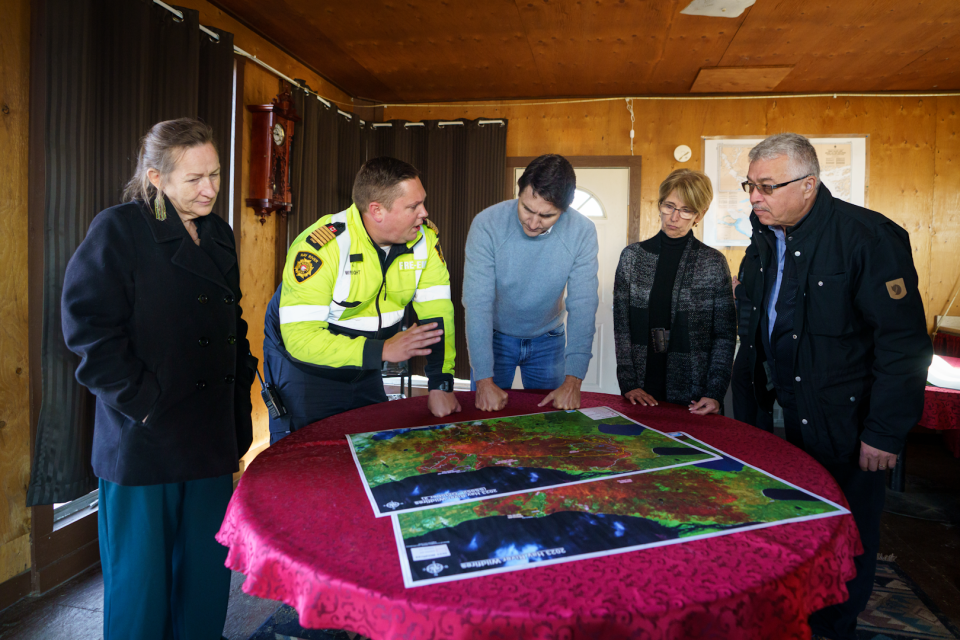
“We’re looking into acquiring some equipment that’s going to allow us to rapidly respond to any wildfire risks within the community,” Wright told Tuesday evening’s audience.
“We’ve gone out to seek a partnership with Aurora Ford for a vehicle. We’re getting a skid package put in and we’ll be outfitting it with wildfire-specific equipment – because as it stands right now, we’re set up for structural firefighting and that’s the world we’ve lived in. But we understand that there are risks elsewhere.
Advertisement.
Advertisement.
“We’re making sure that we’re getting ourselves equipped and trained to deal with that within the community boundaries.”
More firesmarting
Hay River wants residents to step up their firesmarting game, which will come with incentives from the town.
“On a weekly basis, we’ll be posting a firesmart message out to the community and tips on where you can access resources. We’re looking to install a sign in the downtown area where it’s conveniently located for the general public to indicate the fire risks,” said Wright.
“We’re going to have a home assessment program. We’ll come to your home and assess for wildfire, whatever your firesmart risks are, and identify what you can do to correct it. If people make the effort to correct that, we’ll look at some sort of a reward system, maybe entry into a draw for some things.”
The town will also help with pickup of the brush and other materials people clear while they’re firesmarting between now and mid-June.
Town council, meanwhile, will be asked to look at changing its bylaws to allow action if failure to firesmart poses a risk to neighbouring properties.
“Firesmarting does work. It’s been proven to work and we’re really going to try and promote that this year and support it,” said Wright.
Quicker notifications
Allaire said ECC and the Department of Municipal and Community Affairs will change the point at which communities are notified of wildfires that could pose a threat.
Advertisement.
Advertisement.
“We heard that people want to be notified earlier,” he said.
Up to and including last year, Allaire said, the protocol set out that communities would be informed when a wildfire was 30 kilometres from a community or closer.
Last year, though, wildfires “moved way quicker than we expected,” Allaire acknowledged.
“The rate of spread we had last year was phenomenal. I’ve never seen fire moving 21 kilometres in two hours. That was unheard of,” he said.
“Now, we’re looking at notifying the communities at maybe 50 or 60 kilometres – we don’t want to panic people, that’s another thing too. We’re going to have more communication, giving more information about what’s happening with the fire.”
More: Watch Tuesday’s meeting in full
Cindy Caudron, a resident who spoke at the meeting, said knowing what’s happening was key.
“When it really impacted me, the magnitude of [2023’s fires], was when the chief of the reserve went up in the helicopter and went around the whole town,” Caudron said, describing video Chief April Martel shot from a helicopter of the fires below.
Advertisement.
Advertisement.
Only then “did I actually get an idea of the magnitude of the fire, because when I’m getting pictures on Facebook, I don’t see any fire – I see smoke, but I don’t see fire,” Caudron said.
“When she went up in the helicopter, that was an important thing to do. Visuals are really important to people.”
Neighbourhood groups?
Linda Carman, another resident who spoke, described her concern about the way in which evacuations are communicated to seniors and others.
“In all three evacuations, there were various members of people in my neighbourhood who did not know. And it was really stressful knowing that they didn’t know and trying to help them,” Carman said.
“We tried to access services to support them and we had enough of a load on ourselves. It was too much to take on.”
Carman wants Hay River neighbourhoods to take some responsibility for this themselves. She suggested drawing up neighbourhood plans “where we actually know who our neighbours are, know when they’re home, know who’s home, know who to go and knock on the door right off the hop.”
Neighbourhood groups could also help to firesmart when people are unable to do so themselves, she added.
Town manager Smith, who spent some of the evening reiterating the importance of individual residents having their own plans and taking preventative actions, welcomed that suggestion, although it wasn’t immediately clear how that would be turned into a reality.
“Governments can try to implement programs,” Smith said, “but we’ve got to look after each other. We’ve got to know who lives next door to us, who might have an issue.”
