



Advertisement.
Filling the Site C reservoir in British Columbia is expected to have “a relatively minor impact” on water levels in the NWT, the territorial government says.
BC Hydro announced it had begun filling the reservoir for the province’s new hydroelectric dam, near Fort St John, on Sunday.
The corporation said filling the reservoir will take two to four months, with the reservoir’s water levels rising by 30 cm to three metres a day.
The dam is on the Peace River, which flows from BC through Alberta to the Peace-Athabasca Delta and into the Slave River, which carries the water into the NWT.
Advertisement.
Advertisement.
During a Wednesday public briefing on water levels in the NWT – which have been at record lows in some areas this year – territorial officials said filling the Site C reservoir should have a minimal impact on those downstream water levels compared to the effects of an ongoing two-year drought.
The NWT’s Department of Environment and Climate Change projects a maximum drop of 8.5 cm on Great Slave Lake from filling the Site C reservoir. The department said this will not be a permanent loss of water and it expects levels to recover as more water moves through the river system.
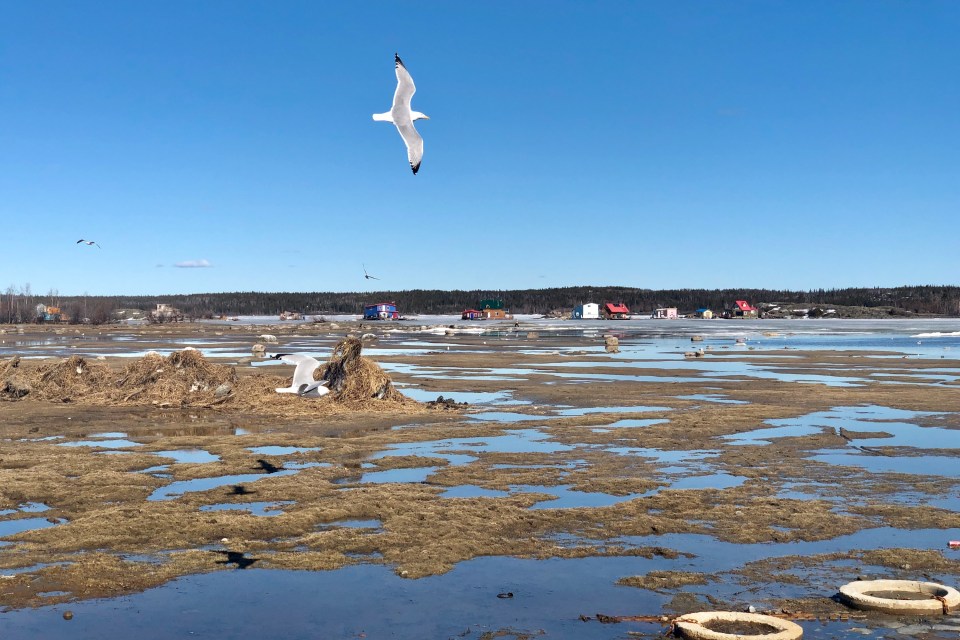
Putting that drop into context, assistant deputy minister Julian Kanigan said water levels on the lake have dropped by more than 120 cm due to climate-driven drought over the past two years.
The NWT has been in drought since the summer of 2022, which hydrologists say is the reason for historically low water levels. Recent extreme drought conditions were preceded by record high water levels and historic flooding in some regions.
Advertisement.
Advertisement.
“Scientists have been saying for many years that climate change will lead to an increased frequency and magnitude of extreme events including high precipitation and widespread drought. The NWT has witnessed both of the extremes over the last five years,” said Ryan Connon, a territorial government hydrologist.
‘The meat in the sandwich’
Given the low water levels on Great Slave Lake, Kanigan said the NWT’s environment minister wrote to BC Hydro last summer to ask about delaying the filling of Site C’s reservoir. BC Hydro had responded, Kanigan said, that the company did not believe there would be any impact to downstream water levels.
Territorial officials have said they are drafting a letter to BC Hydro to initiate an information-sharing agreement on the project. The current transboundary water agreement between the NWT and BC applies to the Liard River, but not the Peace River, as the Peace River flows into Alberta and not directly into the territory.
Deputy minister Erin Kelly said Alberta had described itself in negotiations as “the meat in the sandwich.”
“We’re hoping we can have an information-sharing agreement so we’re getting that information directly from BC as well,” Kelly said
Looking ahead
Discussing future precipitation in the NWT, Connon said on Wednesday it’s “more likely than not” that the territory will get more snow than usual this winter as this part of the planet transitions to La Niña. Whereas the El Niño Pacific climate pattern can make Canada dryer and warmer than usual, its companion La Niña can bring more precipitation as it pushes the jet stream to the north.
Kelly said whether that increased snow eases the drought depends on where it falls in the territory and the conditions when it melts. For example, she said, if that snow evaporates in the atmosphere, it won’t improve conditions.
“Our hope is that we get as much snow as we possibly can and that it ends up in the systems in the NWT,” she said.
Advertisement.
Advertisement.
Environment minister Jay Macdonald noted that, according to a forecast at the start of the 2024 wildfire season, the territory would require about three times its normal level of precipitation to get out of the current drought.
Kearl dispute resolution
During Wednesday’s briefing, officials also provided an update on the dispute resolution process between the NWT and Alberta related to a tailings pond leak and massive spill at Imperial Oil’s Kearl oil sands project.
The NWT government initiated dispute resolution in March 2023 over concern that Alberta had failed to notify the territory about the incidents, as is required under a bilateral water management agreement.
According to Wednesday’s presentation, the province and territory are working to resolve the dispute by improving Alberta’s notification protocols and establishing clear criteria that would trigger notification.
Kelly said this was not the first time the territory had not received information as expected from the Alberta government, but things had improved since the Kearl spill.
“There’s an interpretation of the agreement where Alberta has said what was happening at Kearl would not have impacted the waters … of the NWT, so they didn’t, under the agreement, have to tell us,” she explained.
“They have been really good about understanding why, when things are in the media, it’s important that we know in advance and that we can provide information to communities, and why increased information-sharing with us is beneficial,” said Kelly, “to the point where we’ve received more information on small spills than we actually think we need to receive.”
