



The Inuvialuit Regional Corporation will focus on preventing children from being taken into care as it takes control of child and family services for its members.
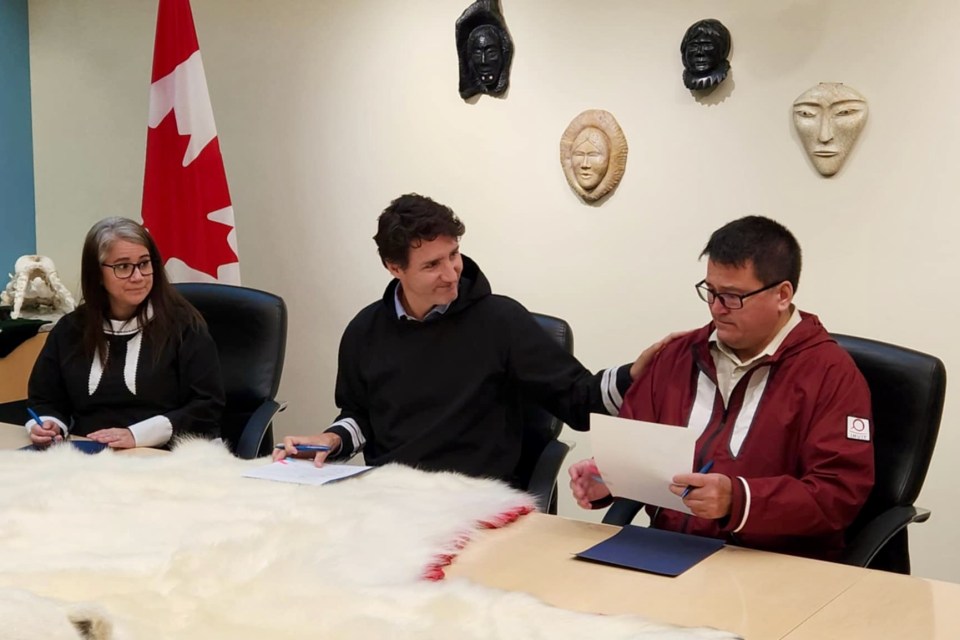
On Monday, the IRC signed a landmark coordination agreement with the federal and NWT governments that paves the way for Inuvialuit to take greater responsibility for those services.
The governments said the agreement “prioritizes cultural continuity, enhances supports for families and improves information-sharing.”
Speaking with reporters after that announcement, IRC Chair Duane Ningaqsiq Smith said the agreement – and $534 million in associated federal funding over the next 10 years – will allow the organization to enhance capacity, skills and training, as well as build infrastructure like youth wellness centres.
Smith pointed to programming the IRC offers, such as a family life skills program and an on-the-land facility, as opportunities to build family bonds and skills.
Advertisement.
Advertisement.
“With residential schools, children were separated for years from their parents,” he said.
“You can see that in some of the generations where they haven’t been able to properly develop [such] skills as parenting, and now we have that ability, and we’re slowly starting to build up those programs, those services.”
Smith added that the IRC has agreements with the Yukon, BC and Ontario to share information about Inuvialuit living in those jurisdictions.
“We do realize that, in some cases, it’s still in the best interest for that child, depending on their individual situation – that we might not be able to provide the adequate services and attention that they need. They would still be somewhere in the south getting that proper care,” he said.
Advertisement.
Advertisement.
Prime Minister Justin Trudeau, in Inuvik to sign the agreement, said: “The focus that the Inuvialuit Regional Corporation took on this is really about prevention, understanding that the best thing for kids at risk is to make sure that they don’t get at risk.”
He gave examples like community support and addictions services alongside investments in housing.
“At the same time, we know some kids will be in extremely difficult situations,” Trudeau said.
“What this agreement means is that the Government of the Northwest Territories will work closer with IRC to make sure that there is proper, appropriate supports and culturally appropriate conditions for kids who need to be protected.”
According to territorial data, of the 1,102 children and youth that received prevention or protection services in the NWT between April 2022 and March 2023, 97 percent were Indigenous.
Of those, 76 percent were First Nations, 16 percent were Inuit and five percent were Métis. Comparatively, 57 percent of the territory’s total child and youth population is Indigenous.
In 2020, federal legislation came into force recognizing the right of Indigenous communities and groups to develop their own child and family policies and laws, with the aim of reducing the number of Indigenous children in care.
The IRC passed its own child and family services law – Inuvialuit Qitunrariit Inuuniarnikkun Maligaksat, or Inuvialuit Family Way of Living Law – in 2021. It was the first Inuit organization in Canada and the first Indigenous organization in the NWT to do so.
Advertisement.
Advertisement.
Trudeau on Monday said he hopes the coordination agreement with the IRC will “be held up as a path forward.”
“We know that so much of the future goes through ensuring that young people have the opportunities, have the sense of identity, of self, optimism, of pride that comes from language, traditional knowledge, learning from their Elders about who they are and where they’re going,” Trudeau said.
He described removing Indigenous children from their language and culture as “a different version of the terrible mistake that Canada had made with residential schools.”
Trudeau particularly praised the NWT government for being party to the agreement, saying some provincial governments are challenging Ottawa’s efforts to allow Indigenous governments greater control over child and family services.
The NWT government had earlier joined a Quebec legal challenge of the federal legislation, arguing that in cases where the territorial and Indigenous governments disagreed, the territory should have the final say over children in care. The Supreme Court of Canada upheld the federal act earlier this year.
Bill proposes criminalizing residential school denial
Speaking in Inuvik during National Day for Truth and Reconciliation on Monday, Trudeau addressed several related questions from reporters.
The prime minister said his government “will look carefully” at an independent member’s bill that proposes criminalizing residential school denial.
“Obviously, any time people are putting limits on free speech, a free and democratic society needs to take careful steps,” he said.
Advertisement.
Advertisement.
“We need to work hard at reconciliation, so we’re going to take any proposals by any political party seriously when it comes to advancing reconciliation and making sure that Canadians understand how important it is.”
Leah Gazan, the NDP MP for Winnipeg centre, introduced Bill C-413 in the House of Commons on Thursday. If passed, the bill would criminalize making a public statement that “willfully promotes hatred against Indigenous peoples by condoning, denying, downplaying or justifying the Indian residential school system in Canada or by misrepresenting facts relating to it.”
“Survivors and their families deserve to heal from this intergenerational tragedy and be free from violent hate. We cannot allow their safety and well-being to be put further at risk,” Gazan told the House.
The wording of the proposed bill is similar to a section of the criminal code that states it is an offence to promote antisemitism by “condoning, denying or downplaying the Holocaust.” The Liberal government outlawed Holocaust denial in 2022.
IRC sending delegation to New Mexico
Smith on Monday also provided an update on an Inuvialuit burial sites project.
Earlier this year, the federal government committed more than $845,000 over two years to help the IRC locate, document and memorialize the burial sites of children who never came home from residential schools.
Smith said the IRC had recently been approached by the University of New Mexico about artifacts from the Inuvialuit region and the University of Chicago about human remains from coastal communities.
He said the IRC will soon send a delegation to start repatriating those remains.
