


One of Yellowknife’s soccer clubs says organizations don’t get equal access to practice and game space at the municipally owned fieldhouse.
During the many months of each year in which outdoor soccer is not practical in Yellowknife, the fieldhouse’s two indoor surfaces are in high demand.
The YK Galaxy Soccer Academy says priority historically goes to whichever club has been operating the longest. The club says that policy prevents newcomer businesses from growing to meet demand.
Coach Knox Makumbe has been with YK Galaxy since its inception in 2018. He played soccer in university in Zimbabwe before moving to Yellowknife.
“I wasn’t the strongest, but I just loved soccer a lot,” said Makumbe.
Advertisement.
Advertisement.
He feels the club hasn’t always been recognized for the work it does, such as taking its U15 boys to nationals in Ontario, where the team won one of its games – “quite an achievement,” he said, for a small territory at national level.
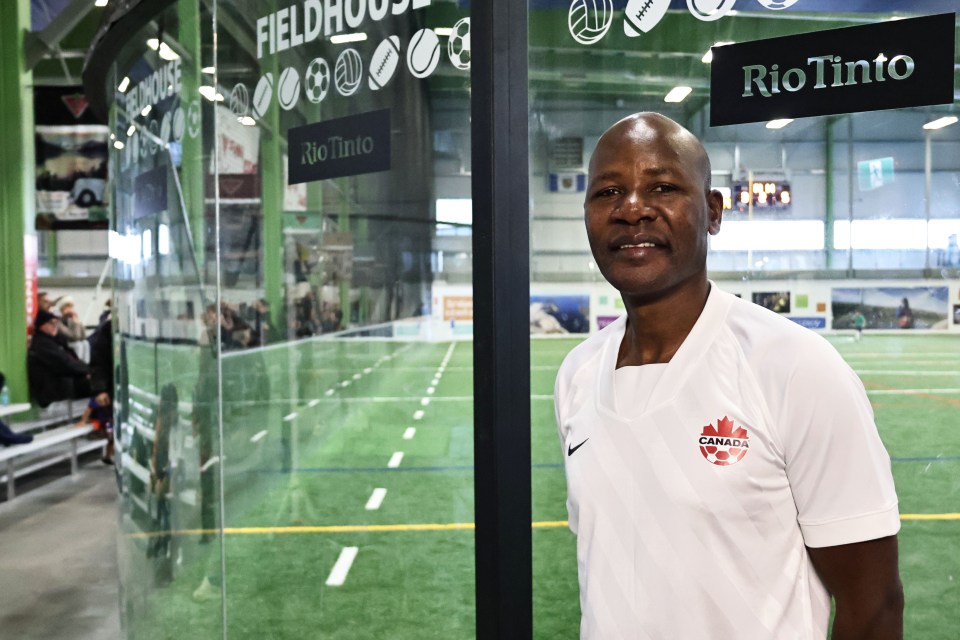
Makumbe says the club is achieving success despite not having fair access to field time.
“We have half our time here, half time at the gym. But other teams, other clubs, they get all the time they want,” he said, explaining that he practises twice a week at the École St Patrick High School gym, which he estimates is about half the size of a fieldhouse pitch.
Every year, clubs submit a list of hours during which they would like to use the facility’s two fields. Clubs that have been around longer get the times they request, said Makumbe.
Advertisement.
Advertisement.
Whenever YK Galaxy and another club request the same time, he said, “we know we are not going to get that – they’re going to give it to somebody else.”
YK Galaxy administrative coordinator Defny Torindo said an agreement put in place when the fieldhouse was built gives priority access to existing clubs.
The City of Yellowknife, approached multiple times for comment over the first two weeks of January, had not responded by the time of publication.
After the article had been published, the city said in a statement that it “works hard to ensure all user groups have a space and time for their programs that is as close to what they request.”
Confirming the city’s policy of granting slots to groups that have historically held them, a spokesperson said that approach was “created with the direct input of user groups when it was established and focuses on the collaborative and conciliatory nature of allocating facility availability to heed the fairest results for all groups.”
‘Plenty’ of unused time
Joe Acorn is a coach and founder of the Yellowknife Bay Soccer Club, known as Sundogs, that has been in operation since 2009.
He said there is “plenty of time” available for groups who want greater access to the fieldhouse.
“This is a matter of whether or not the groups want the time that’s available to them,” said Acorn.
Advertisement.
Advertisement.
When his teams play in Edmonton, he said, the city’s fields are in use as of 7am on the weekend, and the same is true for hockey arenas in Yellowknife.
He said Sundogs normally practises at the fieldhouse on weekday evenings and on weekend mornings.
When the fieldhouse opened in 2011, Sundogs was still relatively new to the Yellowknife soccer scene and Acorn said it had last priority for booking space.
As a result, the club could only reserve 3:30-5pm on Mondays through Wednesdays to play and practise.
“It worked fine. The kids used to leave school and go right to the fieldhouse,” said Acorn.
He added he used to have to work on Saturdays to make up for time he lost to soccer practices during the week.
“That was the sacrifice to be made to get the time that I wanted,” said Acorn.
As other user groups dropped off, he said, Sundogs began to get first pick for field times.
Advertisement.
Advertisement.
Acorn said he’d like to see the existing system for reserving space continue, though if new field time were to become available – for example, if one group cancels a booking – he thinks it would be fair for that to be offered to all groups at the same time.
“It’s really hard to come up with one rule that fits all the different types of uses of the building, so the one that’s been in place for 15 years – honestly, it has worked for the most part,” said Acorn.
YK Galaxy founder and coach Dillon Torindo said he sometimes sees fields unoccupied when they have been reserved by other groups. He has asked the city about this on more than one occasion, he said, but received no meaningful response.
Rules elsewhere
In some cities, Makumbe said, organizations operating for two years or more get equal access to municipally owned facilities. He’d like to see something similar adopted in Yellowknife.
Defny Torindo said the club has grown from about 60 players in 2018 to 200 now, with a long waitlist of young people eager to join.
Currently, the club says it needs 10 to 20 more hours of field time every week to meet the demand for its programs and continue to grow.
Makumbe said the current procedure doesn’t seem fair.
“It means all immigrant businesses that want to start here, or newcomers, are not treated fairly,” he said.
Advertisement.
Advertisement.
“The tough part is we talk about non-discrimination, making it fair for everybody, but it doesn’t seem like it applies to this.”
Over the summer, he said, the club was offered 10 extra hours of unused field time during a meeting with the city. Later, he said, those hours were clawed back after the city said it had made a mistake.
More recently, Dillon Torindo said, a parent of a child who plays with YK Galaxy has been advocating on behalf of the club and has met with city officials to discuss modifying the existing policy.
The child, Torindo says, only gets about an hour and 15 minutes to play at the fieldhouse every week.
Torindo said the parent provided recommendations to the city but the club hasn’t heard if those proposed changes will be adopted.
“We’re still waiting to see what’s going to happen this year,” said Torindo.
