



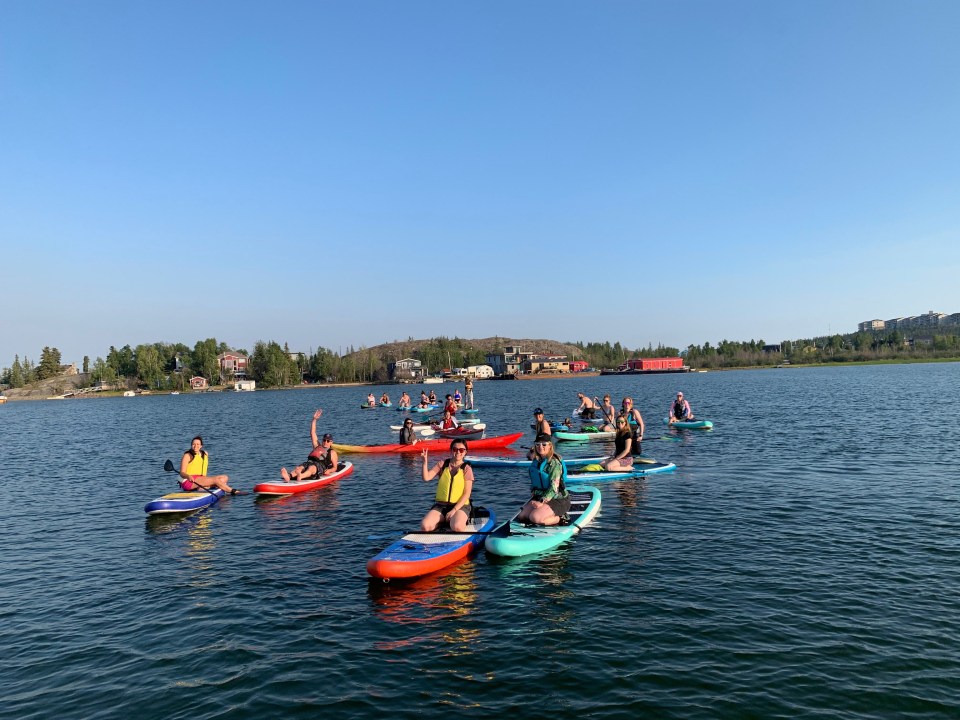
A cold plunge and sauna. Exercise classes. Paddleboarding. An evening out.
These are some of the small steps the NWT Medical Association – which represents the territory’s physicians – says it is taking to try to care for the North’s doctors.
In a December survey, 64 percent of responding doctors told the association they were either planning to leave the territory or had considered it in the past year.
Dr Sarah Cook, a family physician who chairs the association’s wellness committee, calls that figure a “really big red flag.”
In the legislature earlier this month, MLAs were told nine of the territory’s physicians had left their jobs since the beginning of the 2023-24 financial year. Three permanent physicians were hired last year and one so far this year.
Advertisement.
Advertisement.
“Both retirements and resignations” were involved in the decisions of physicians to leave, MLAs heard.
Speaking in her capacity as an association board member, Cook told Cabin Radio a 50-percent vacancy rate is placing remaining staff at risk of burnout.
“As you lose more people, the people who are left behind have a larger burden. At some point that becomes a tipping point that it’s very hard to recover from,” she said.
“I hate to use the word crisis lightly, but it is, in terms of what we see.”
Advertisement.
Advertisement.
Equally, Cook said, the situation in the territory appears no worse than that elsewhere in Canada. The same pressures exist across the country, a topic we’ll examine in a separate article on Wednesday.
Below, read our conversation with Cook about how the NWT Medical Association sees the NWT’s healthcare situation, what’s working, and what isn’t.
You can also listen to this interview in full using the audio player above.
This interview was recorded on February 18, 2025. The transcript has been lightly edited for clarity.
Ollie Williams: How are things going right now?
Dr Sarah Cook: Things are, broadly speaking, challenging for all involved in the healthcare system, although there are definitely some bright spots. When I say challenging, we have increasing vacancy rates in terms of our local physicians, our residing physicians in the Northwest Territories. And as we lose more people, of course, that means more work for those who are left, which, puts people at risk of burnout and then leading to a risk of further attrition. So that’s definitely challenging, but there are some positive things happening.
Give us the silver lining so we can understand those positive things before we look a little bit more at the challenges.
As a medical association board member working on wellness, we’ve been really working to try to think of ways we can support physicians in terms of their wellness, which we believe will then contribute to recruitment and retention.
Advertisement.
Advertisement.
We are very fortunate this year to have received some funding through an affinity fund from a combination of the Canadian Medical Association, MD Financial and Scotiabank, and that fund is specifically focused on physician health and wellness. Because of that funding, we’re able to put on some events to try to support wellness.
Tell me about these events.
We have three different streams of initiatives we have put on in the past year. One we are calling “MD Connect.” These are events that bring people together to build community and do things that are wellness-related.
The second one is reconciliation and cultural safety events, working to help people have better cultural safety in their practices and lives, and think about how they can contribute to reconciliation efforts.
And the third one is coaching. So we’ve provided funding to physicians individually to pursue coaching for things that they feel are going to be important, whether it’s work-life balance or a particular challenge that they’re experiencing, whatever they feel is going to contribute to their wellness.

The MD Connect events happen about once a month. For the most recent one, we gathered physicians together in Yellowknife – both local and locum, so our visiting physicians – to go out to the Arctic Duchess for the sauna and plunge. And really the purpose of that was giving people an opportunity to connect outside of work and give them some time to do something that we know is really good for their health.
Was it always your association’s role to do that or has it stepped up to deal with circumstance?
Definitely stepped up to deal with circumstance.
Advertisement.
Advertisement.
If you look at the actual mandate of the medical association, it is the voice of physicians in the Northwest Territories. We advocate on behalf of members and citizens of the North for access to high-quality healthcare and we provide leadership and guidance to members. There’s nothing in there, particularly, about wellness.
But we recognize that to provide high-quality care to the citizens of the North, which is what we care about, we need to have well physicians, and so that’s where the concept of caring for the carers comes from.
We recognize that this is a really important part of the mandate now, given the amount of challenge that people are facing in the attrition that we’re seeing. We are close to a 50-percent vacancy rate for both family physicians and specialists, of local physicians, in the territory. And it’s getting worse.
From the association’s point of view, why are we at risk of not having well physicians?
As you lose more people, the people who are left behind have a larger burden. At some point that becomes a tipping point that it’s very hard to recover from. Our stance right now is that… you know, I hate to use the word crisis lightly, but it is, in terms of what we see.
Define the parameters of the crisis for me. Is it a crisis among physicians? Is it a crisis across the entirety of the NWT healthcare system? What are you pointing to?
I think there are multiple parts of the system that we could probably use that term for, but I’ll give you specifically the thing that is concerning us the most right now, which is a survey we did of our members in December.
One of the questions we asked our physician members was: “Are you considering or have you decided to leave the Northwest Territories and terminate your contract here?” Sixty-four percent in the last 12 months have said they’ve considered or have decided to leave.
Advertisement.
Advertisement.
How many would actually follow through? Tough to say, but I think that is a really big red flag. It’s an alarm that we need to listen to.
Has the association done the survey before?
No.
So that is baseline data and you’re going to get the opportunity to see how that number shifts on the dial.
That’s the hope, yes.
It’s not to say that we think our wellness events are going to be the thing that necessarily makes that difference. This is definitely multifactorial, but whatever we can do to help people connect and feel supported is really important. Why do we need to remind people there’s a sauna and they can go to it? It’s not that people aren’t doing things in their spare time for wellness. I think people probably are. But the ability to try to also connect with one another, to be able to have peer support and not feel isolated and alone, is really, really important and really effective.
In that survey, we also asked people: “What are the things keeping you here, and what are the things making you want to go?” That was really valuable information, too because, not surprisingly, the things that keep people here are about community and about people.
Members talked about the strength of the professional community and how important that is, again tied into these wellness events, and why we want to help people to connect. They talked about the opportunity to serve in areas of high need and to contribute to reconciliation efforts. They talked about really engaging in diverse work here. People really love the work, the actual work – having amazing colleagues who are leaders in their fields, award winners, committed to their patients, dedicated to improving patient care, eager to problem-solve. I’m reading some of the actual results from the survey. Love of the outdoors, of course, a strong sense of community outside of work as well.
Advertisement.
Advertisement.
There are lots of really great things. People want to come and work here, but there are also some big challenges, and so that’s what we’re trying to mitigate.
A lot of stuff seems to have been thrown at the wall over the last few years when it comes to recruiting and retaining healthcare workers. Of all the things being thrown at the wall, what’s working?
I think we collectively all want to provide great care, and so I think the direction is the right one to really think about: how do we work better together in interdisciplinary ways across different professions? How do we each optimize our scope of practice and work together to really meet the needs of what patients need, what people need?
I think this is not just about money. That’s not necessarily always the solution. It is about doing things better, more efficiently. And clinicians – whether it’s physicians or nurses or program assistants, anyone who is working on the front line directly with patients – often will have a very good idea and very good insight into what some of the solutions are.
So it’s those people who are working on that front line who can see some of the inefficiencies that maybe are not seen at higher management levels – and there are efficiencies, and there are innovations, and there are ways we can work better together to meet the needs of patients.
That is one of the things we heard in the survey: people want to be able to improve care. They so, so deeply believe this is why we went into medicine, because we want to do a good job and we want to help people. To work in a situation where you feel the system could be serving a patient better but doesn’t? It is very, very difficult for the patient and it’s also very, very difficult for the healthcare provider, who feels that they don’t have it within their ability to make the improvement that needs to happen.
From a physician’s point of view, what do we know about how the NWT and its system and the challenges here compare to the rest of Canada? Is the grass greener anywhere else?
No, our healthcare systems are challenged everywhere, and I think that’s evidenced by the often-cited statistic that 6.5 million Canadians don’t have a family physician in Canada right now, and another six million patients have a family physician who’s going to retire in the next five years. There’s a looming crisis in primary care across the country.
Advertisement.
Advertisement.
I think it’s also difficult to compare between provinces and territories on a really broad scale, unless you’re looking at very specific indicators. But I wouldn’t say it’s necessarily significantly worse here. I think we have these challenges everywhere, but that doesn’t mean we shouldn’t try to make it better.
The impression I get nationally is of 13 provincial and territorial canoes moving closer to the edge of the waterfall, and a lot of reverse paddling is happening. I guess I’m not clear if we’re ever going to reach escape velocity to avoid the situation you’ve just outlined. We’re approaching a cliff where we’ve got millions of people whose doctors are about to retire, and millions more people who didn’t have a doctor in the first place. And here we are as the Northwest Territories being like, “We’ve got to fix this. We’ve got to get this right.” But is the problem bigger than us? Can the Northwest Territories paddle its canoe somehow better than everybody else to be in a better position? Or are we really just tied to what happens nationally?
I don’t think we’re entirely tied. Actually, we have some significant strengths here that allow us to have the opportunity to paddle separately.
Having salaried physicians makes a difference. So our contract physicians here are almost all salaried, and that makes a difference in terms of the model of care that is enabled. A lot of physicians in Canada are what’s called fee-for-service, meaning they’re billing for every appointment and every procedure that is done. It’s a very different model than a salaried model, in which there’s more leeway to figure out together, as a system, what is the best utilization of physician time, rather than it being tied to “if I do this particular thing I get paid this amount,” which is what the fee-for-service model is. I think that gives us leeway for innovation and how we use the physician workforce.
We also have a single electronic medical record, which is really huge, and we’ve had that for so long. We were one of the first jurisdictions to have that in Canada and other jurisdictions do have that now. But having informational continuity is a huge strength, meaning that your information follows wherever you are. If you are in Inuvik, or you are in Yellowknife in the emergency department, or you travel to Fort Good Hope and you get seen in the health centre, it is one single record, including our specialists and allied health. That is huge, to have all the information in one place.
The third thing is we have a real interest and engagement in interdisciplinary team-based care. Everybody is kind-of going in the same direction here: everybody wants to do that, and that’s not the case everywhere.
I think those are three really big strengths we have that would allow us, given the right conditions, to go away from that waterfall, but we need to figure out how to better utilize the resources we have, the physicians we have. Do we have enough physicians right now? No, we do not. But can we also work differently as physicians? Are there other health professionals on our teams that can do more of the role that maybe physicians are doing now or have done in the past? What can we do to better work together as a team in an interdisciplinary setting?
That’s a national conversation that’s happening, for sure, but we have an ability to move forward with that, I think, more easily here than other places.
Aastha Sethi contributed reporting.
