



Advertisement.
A new report examines efforts to help recovery of the Northwest Territories’ wood bison herds over the past five years.
Bison in the territory are split into Mackenzie, Nahanni and Greater Wood Buffalo groups. They are listed as a threatened species in Canada as a whole and in the NWT, too.
That status will be reviewed next year. The newly published progress report on actions to help the bison is the first such document to be produced after a recovery strategy was put in place in 2019.
The report lists the actions being taken, most of which are still in progress – things like population surveys, harvest management, responding to diseases like anthrax and efforts to reduce the number of vehicle collisions.
Advertisement.
Advertisement.
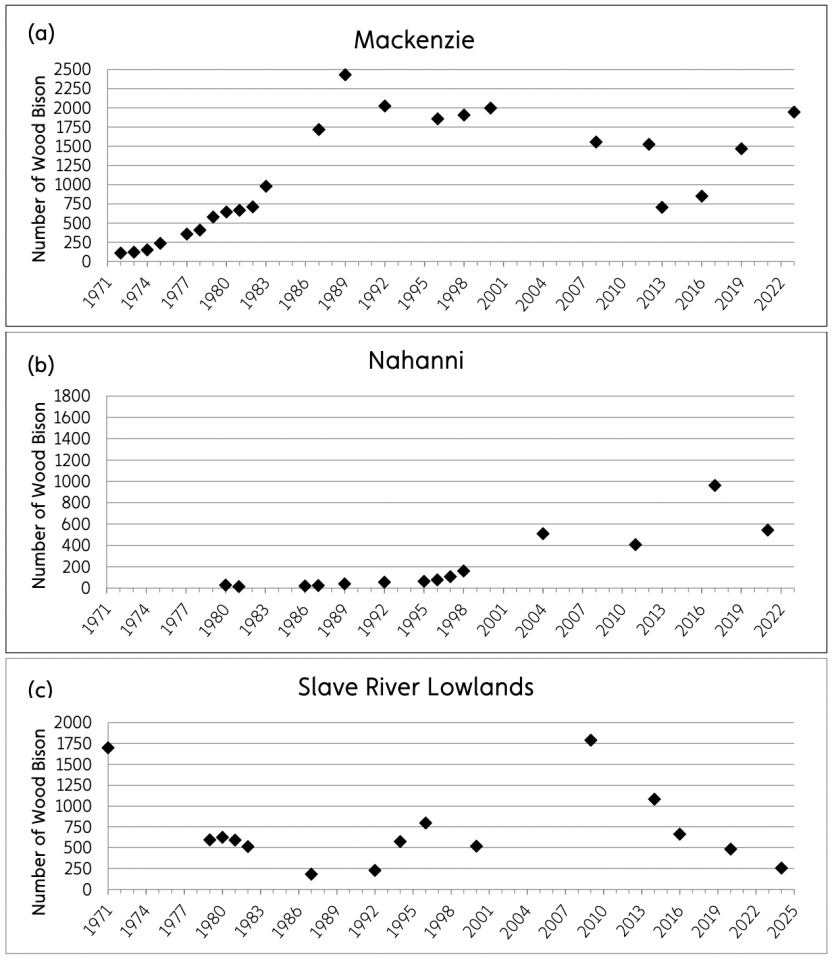
In general, the Mackenzie herd seems to be rebounding after a big anthrax outbreak in 2012.
Nahanni herd numbers were down from an estimated 962 animals in 2017 to 544 at last count in 2021, with 2022 bringing a further eight dead bison and reports of others being found sick or skinny due to starvation, “likely due to the cumulative effects of deep snowpack that winter, low productivity that summer and poor nutrition.”
The Slave River Lowlands bison have been in steady decline since 2009.
Hunting of the Mackenzie bison resumed in 2021 after the 2012 anthrax outbreak killed nearly 40 percent of the group. Forty male bison can be hunted each year, with the season now open year-round.
Advertisement.
Advertisement.
The Nahanni group has a hunting quota of seven male bison per year. Bison can’t be harvested inside Wood Buffalo National Park.
Bison are a constant presence on various NWT highways. The report states that between 2020 and 2024, most years were “below the long-term average of 12 bison collisions per year,” referring to data reported to the Department of Environment and Climate Change. The exception was 2020, which involved 31 reported collisions.
The latest estimates place the Mackenzie herd at 1,945 bison (2023), the Nahanni herd at 544 (2021) and the Greater Wood Buffalo herd at 2,430 (2024), for a total of just under 5,000 bison across all of those areas.
Of nearly 60 actions listed to help the herds, two are not being implemented.
A plan to promote the likes of bison-viewing tourism has not been followed up on, and efforts to eliminate two diseases that can kill bison – tuberculosis and brucellosis – have not begun.
“Elimination of bovine tuberculosis and brucellosis from the NWT is not considered feasible at this time,” the progress report states. Instead, steps are taken to try to manage transmission of those diseases.
