



You may not be able to tell a glyptodon from a megatherium. But your tour guides can – and they’re, like, seven.
When the Prince of Wales Northern Heritage Centre’s latest exhibit opens this week, it might break a territorial record for youngest average age of curator.
The whole thing was put together by students in grades 1, 2, 7 and 8 at Yellowknife’s Mildred Hall School, who set it up in their classrooms before impressed territorial museum staff stepped in.
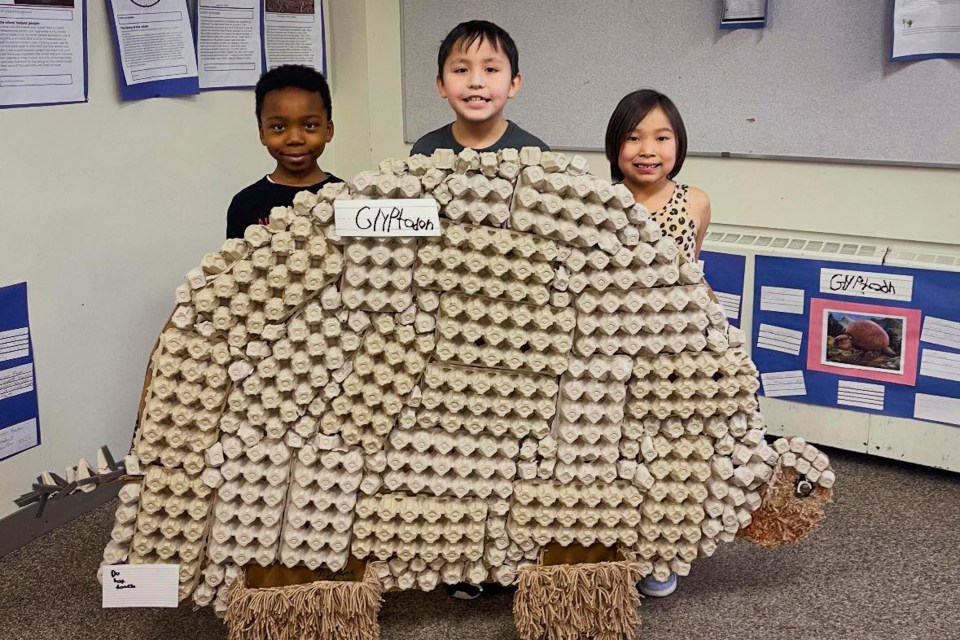
The exhibit – titled Stone and Bone to Code and Chrome: Ice Age to the Information Age – relays the history of the Earth with a focus on some of the big beasts that died out millions of years ago.
Creating the animals involved vast quantities of cardboard and weeks of work. Adult volunteers came into help young students with hot glue guns, while kids came up with novel solutions to tricky problems. Can’t get your giant sloth to stand up the way it should? Build a tree for it to lean on.
Advertisement.
Advertisement.
“It just looked really good and I was really proud of myself,” said Thi, a student in the class of Ashley Deavu, a grade 1 and 2 teacher at Mildred Hall.
“Our principal said we can make a little museum in our school. And then we invited the museum people to come, and then they came, and then they said, ‘Oh, these are so great that maybe we can move them there.'”
The exhibit’s first opening inside the school was a big deal in its own right. Teachers estimate a hundred or more people came. Now, though, the kids are entering the big leagues.
At 5:30pm on Thursday, February 5, the exhibit has its grand opening inside the Prince of Wales Northern Heritage Centre’s auditorium. The students will be there, ready to guide you and explain what a glyptodon is. (“An armadillo the size of a car,” said Deavu.)
Advertisement.
Advertisement.
You’ll be able to see the installation until February 10.
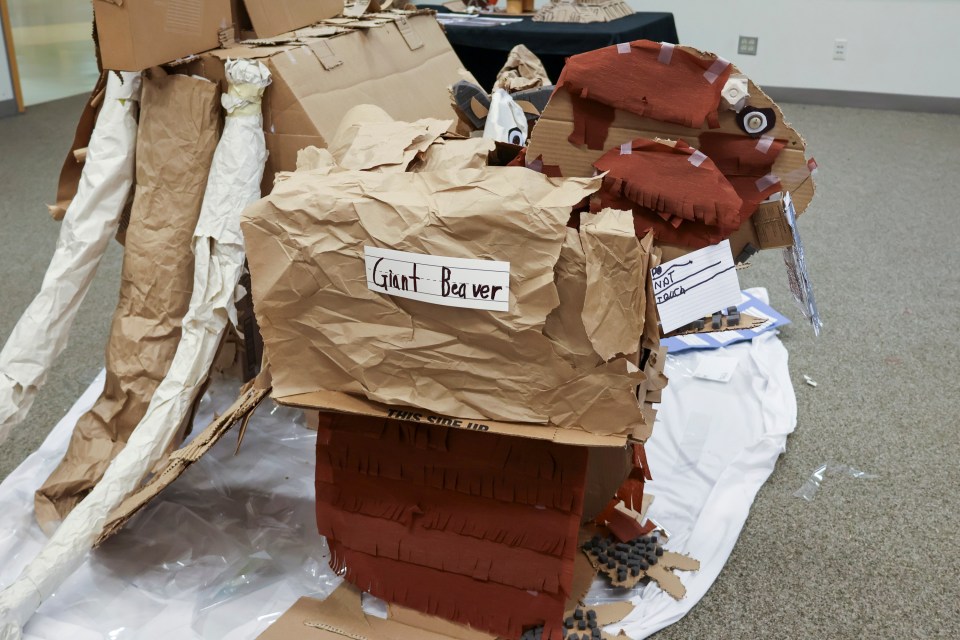
Do not touch
Mike Mitchell, the heritage centre’s assistant director, loves every last thing about this. He’s a former teacher who’s excited to give the students what he calls an authentic audience.
“An authentic audience means that students are doing work not just for the teacher but for somebody else, meaning a community member,” he told Cabin Radio.
“This takes a school project – which was well received at Mildred Hall, I’m sure parents went to see it – to a whole other level. I think it reinforces the value of education and I think it creates a sense of purpose and pride with the student.”

There are two aspects of the exhibit that especially caught Mitchell’s eye.
First, the signs.
“Unfortunately, I think a lot of the students who have visited the museum have come to associate museums with ‘Do not touch,'” he said.
“Almost every object has a sign that says ‘Do not touch. Hands off. Don’t touch.’ I think that’s kind-of cute.”
Advertisement.
Advertisement.
Second, the timeline of the Earth’s history, which was a project led by the older students in grades 7 and 8.
“What I really liked about it is the events that they considered to be historically significant,” said Mitchell.
Historical significance is a real concept historians and curators must navigate, he said. What explains why we consider some things to be important in a historical lens, and others not?
“One of the students had the invention of peanut butter as a major historical event. That says so much about what’s important to different people,” he said.
“There’s a sense of arbitrariness or subjectivity about what’s important in life. And so for a kid, when peanut butter was invented was a very important moment. There was also the invention of microwaves. There was the invention of time. These really big philosophical concepts are treated in the exhibit.”
This week’s new challenge
Deavu, the teacher, had friends who saved the cardboard from a mattress purchase to help make the megatherium (which is a giant ground sloth).
“I can’t say how much it has inspired us to do further things,” she said of the project and its reception.
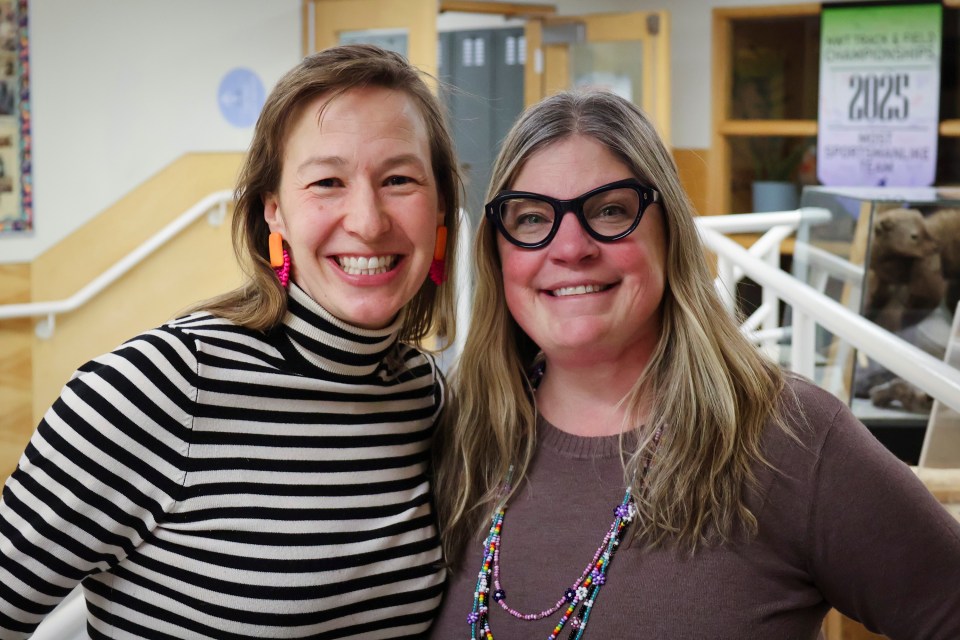
Lea Lamoureux, the school’s principal, tied the exhibit’s development to the territory’s recent switch to a curriculum based on the one taught in British Columbia.
Advertisement.
Advertisement.
“We’re excited to be living the new NWT adapted curriculum that gives so many different entry points for students and their learning,” she said.
None of which mattered to Jacob, another of Deavu’s students, whose main focus was the fun he had putting the legs on the sloth.
“But then I got the flu,” he acknowledged, “so I had to stay home for two weeks and when I got back my team was finished – so I missed lots of the excitement putting the fluff on, making the tree, putting on the tongue and putting on the eyes. I missed all of that.”
Still, there are challenges ahead for Jacob to sink his teeth into.
Animals in the exhibit have to be relocated from the school to the territorial museum this week, ahead of the big opening.
“You have to get your animal there under your own power,” Deavu has told her students. “It’s about a 12-minute walk. It’s very possible.”
“We’re not quite sure how to get that done,” said Jacob, “but we do have a few ideas. We have tarps. We had the idea of making a sled.”
The first time around, the extinctions of the Late Pleistocene did for the glyptodon. This time, in cardboard form and needing to make an outdoor trip across town, the snow in this week’s forecast looks equally dangerous.
“We have a plan B,” said Deavu. “It’s the bus.”
