


The cause of Thursday’s lengthy power outage in Yellowknife isn’t 100-percent clear yet, but the NWT Power Corporation said it suspected “wildlife interference in the substation.”
Now, nobody named ravens in any statement on Thursday night – so it may not have been ravens – but it’s usually ravens.
This has become a cliché in Yellowknife. Anyone who was here at the time can tell you about the flamin’ raven that simultaneously caused a power outage and a wildfire in 2014. Ravens have been routinely blamed for blackouts since.
In other words, this article is the equivalent of a raven writing a book titled If I Did It. We have no proof. But let’s look at why, hypothetically, a raven might end up taking out the power at a substation.
“The heat,” said Stefan Christensen, a system control manager at the NWT Power Corporation, when we interviewed him about this in January.
Advertisement.
Advertisement.
“It’s the heat from the transformers. They like to roost in places that they can perch, where it’s nice and warm, and the transformers provide a lot of heat, so in the winter months they go and roost in substations.
“And they’re big animals. When they take off, their wings can hit a phase to ground or a phase to phase and unfortunately, they cause outages.”
A phase to ground and phase to phase are two types of short circuit. In either instance, the bird’s wings complete a circuit that wasn’t intended, with devastating consequences for power transmission and corvid life expectancy.
“I know everyone hates this answer but yes, it is typically ravens. Ravens do cause an exorbitant amount of outages,” said Christensen last month.
Advertisement.
Advertisement.
As he and Dean Hendrickson, NTPC’s director of energy south operations, gave a tour of the facility, a raven or two could be seen hanging out near the substation infrastructure.
Loud noises, ranging from faked gunshots to anguished bird wails, could be heard playing over nearby speakers.
“We have a programmed sound maker that gives different sounds for ravens in distress to shoo them away, to make them understand there is danger here,” said Hendrickson.
“It is a proven, effective device, but it’s not 100-percent guaranteed, because they are animals and unpredictable.”
The Jackfish substation that delivers power to Yellowknife – and which was the site of Thursday’s incident – even has special adaptations named GreenJackets designed to keep ravens safe. They’re designed to fit over equipment and provide insulation.
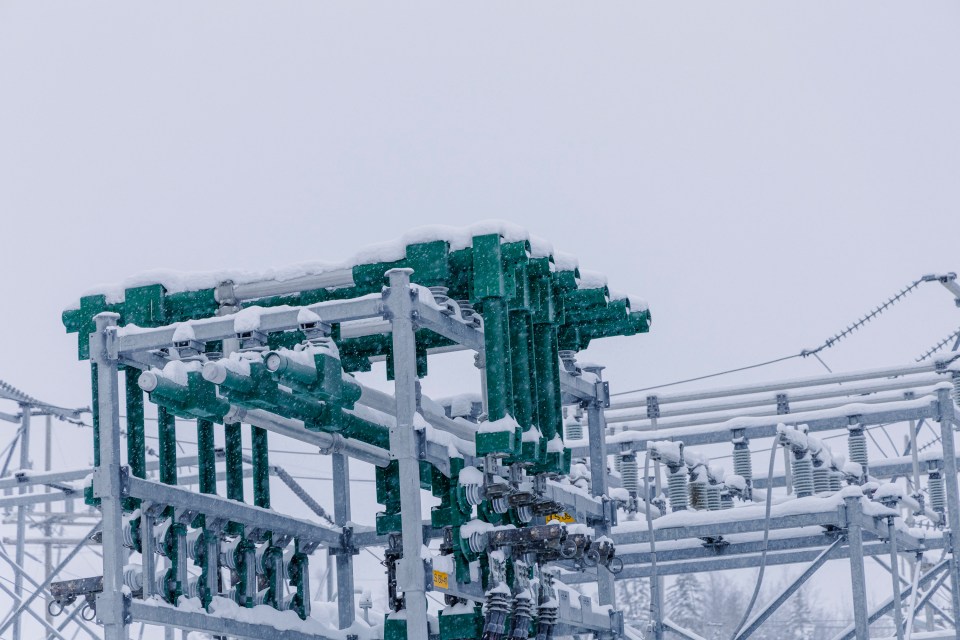
Whether a raven managed to breach these defences and cause Thursday’s outage remains unclear. Another type of animal may have been to blame. Squirrels and ospreys, for example, pose threats of their own.
But ravens stand out, even for people who work at NTPC.
When longtime power corporation staffer Norm McBride retired in 2022, he had all kinds of raven stories to tell.
“There are so many ravens,” he said as he began retired life. “It’s like a lightning bolt, when a raven does get in contact with a conductor. It’s a big bang.
“You don’t see the raven contact. It’s very minimal. But you’ll always see the remains. We started taking pictures, just for verification. Everybody says it’s always the excuse that the power corporation gives, but I guarantee it.”
