


Advertisement.
Work like the Giant Mine remediation is forecast to place the NWT first nationwide this year in proportional growth of spending on major projects.
New Statistics Canada projections give the NWT Canada’s highest expected percentage increase in what the agency calls “investment intentions” – money set to be spent on the likes of resource projects, roads, utilities and other big pieces of infrastructure.
Statistics Canada expects a 14.4-percent year-on-year increase in that kind of investment in the NWT. The next largest is Yukon at 13.5 percent. The national average is 3.7 percent.
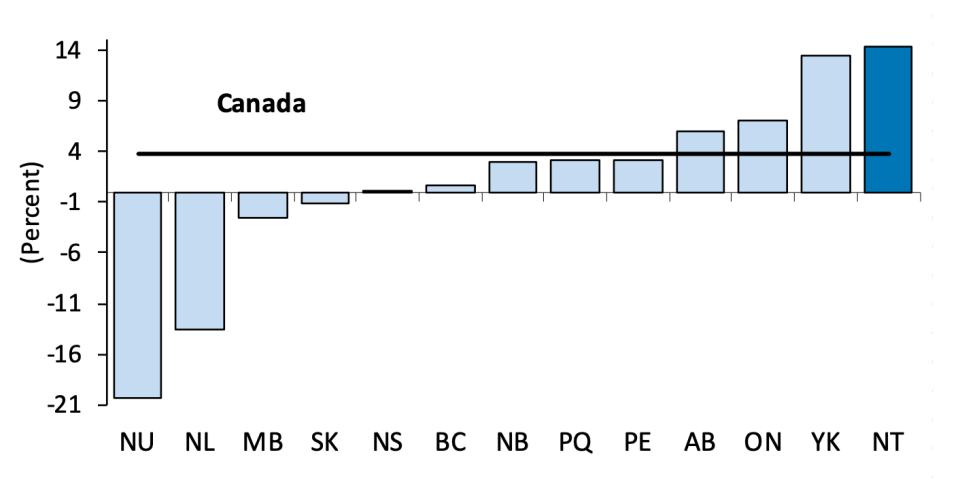
Nunavut, by contrast, is expected to record the largest decline at 20.4 percent.
Advertisement.
Advertisement.
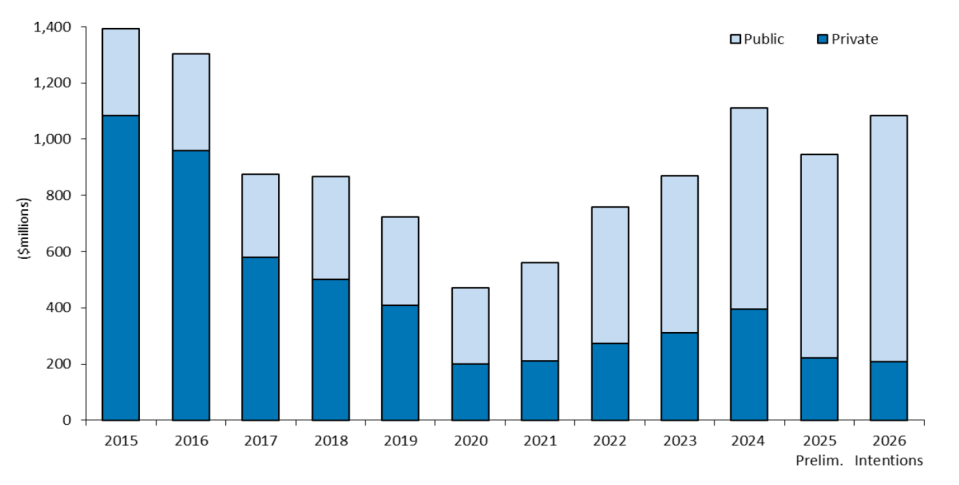
“Prior to Covid, capital expenditures were trending downwards and reached a historic low in 2020. In the years after Covid, expenditures increased until a decline in 2025,” the NWT Bureau of Statistics stated in a news release explaining the forecast.
Last year’s decline in NWT spending “was a result of lower private expenditures, largely due to reduced activity at the diamond mines,” the bureau continued.
“The capital expenditure increase in 2026 is attributed to a rise in public spending intentions, which are estimated to reach $875 million this year.
“The sustained activity in public investment can in part be attributed to projects such as the Giant Mine Remediation Project. In 2026, public expenditures are expected to increase by 20.9%, while private expenditures are expected to decline by 6.9%.”
Advertisement.
Advertisement.
The forecast reflects a broader picture in which the NWT’s private sector, dominated by diamond mining, is suffering. Jobs are being lost, plans are being scaled back and uncertainty is reaching a crescendo.
At the same time, the territory is looking to massive public spending as its medium to long-term economic engine.
That appears likely to come in the form of major military investment – $10 billion for Yellowknife and Inuvik alone in the next 15 years, according to a procurement notice – and projects like the Arctic Corridor from Yellowknife to Nunavut’s Arctic coast, which may soon attract a mix of public and private funding.
The Giant Mine remediation shows the NWT already starting to lean more heavily on publicly funded megaprojects.
Cleaning up the toxic site of the former gold mine, on Yellowknife’s periphery, is expected to cost more than $4 billion.
Giant is an important element of the NWT’s switch, over the past decade, from a capital spending model driven by the private sector to one powered by the public purse.
The federal government has been responsible for the mine site since former operator Royal Oak went into receivership in the late 1990s.
