


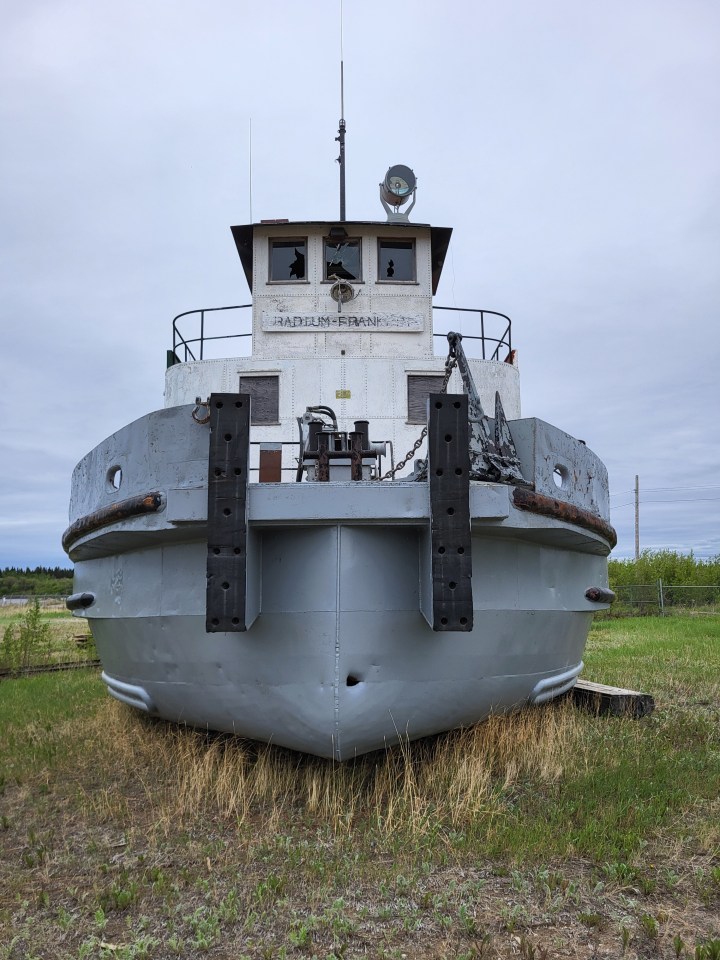
The Hay River Museum Society is seeking federal support to acquire and preserve a historic vessel, the Radium Franklin.
The society has submitted a proposal to the Canadian Northern Economic Development Agency (CanNor) to take ownership of the Radium Franklin, a tug built in 1951 currently sitting at the Marine Transportation Services shipyard in Hay River.
The total cost to move, stabilize and refurbish the boat is estimated at about $150,000.
Tom Lakusta, chair of the Hay River Museum Society, said the Radium Franklin played a role in transporting barges loaded with uranium ore from the Eldorado Mine on Great Bear Lake. That material was later shipped south and used in the Manhattan Project during World War Two.
Lakusta described the mine as an “important and rather controversial project” in the territory’s history.
Advertisement.
Advertisement.
He believes the vessel carries both northern and international historical significance because of that connection, and will help highlight how goods were shipped along the Mackenzie River to supply communities across the NWT and into Nunavut.
“Hay River is the hub of marine transportation – or has been, historically – and so the museum society and Hay River want to have exhibits and celebrate the marine transportation history,” he told Cabin Radio.
Lakusta said while the proposal to CanNor is still under review, a decision could come at any time. The society first expressed interest in the project in the summer of 2025 and later submitted a full application.
If funding is approved, he said CanNor is expected to cover between 70 and 80 percent of the total cost. The museum would look to raise the remaining funds through other sources.
Advertisement.
Advertisement.
Lakusta said the project faces challenges, including restoration work – such as removing old paint that may still contain lead, installing windows and repairing interior spaces – as well as the logistics of moving the vessel. The boat would be permanently mounted at the museum site.
The society is also working to restore its heritage centre, which was destabilized by flooding in 2022.
Lakusta said discussions around acquiring the Radium Franklin date back six or seven years, when MTS first approached the museum offering to donate the vessel. At the time, the society declined the offer due to limited funding and capacity to maintain it.
“We decided it was just too big a project for us at that time,” he said.
“Then they approached us again about three or four years later and said, ‘Are you sure?’ And at that point, we looked a little bit more deeply into what we could do.
“Now that the flood had happened, we had to change our site regardless. It was like, ‘Well, maybe we can do it if we can get funding.’ And so that’s how it started.”
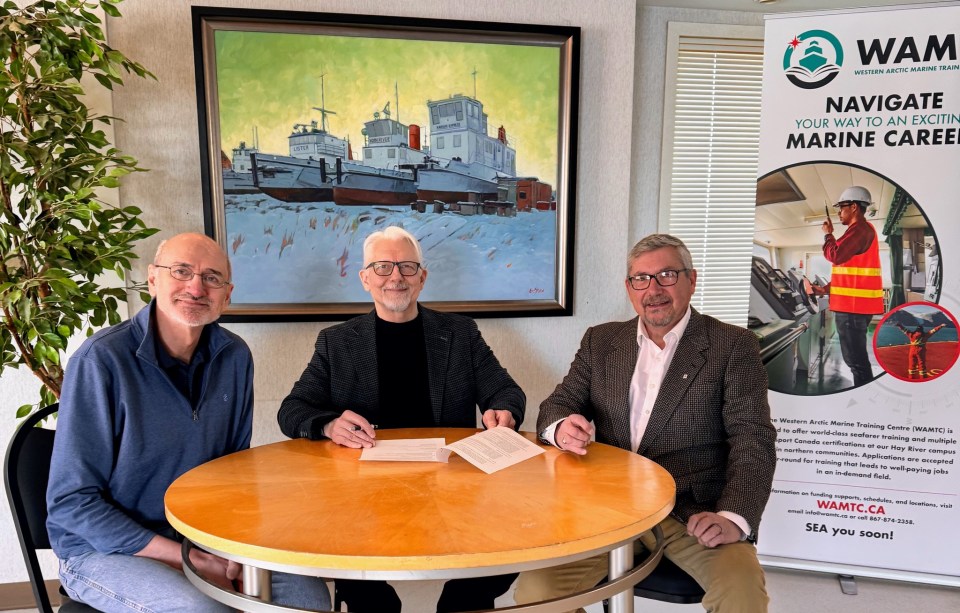
Lakusta said the project is being supported by Marine Transportation Services and the Western Arctic Marine Training Centre.
The museum society recently signed a memorandum of understanding with WAMTC to “advance the preservation and promotion of the maritime history of Hay River and the Mackenzie River system.”
Advertisement.
Advertisement.
He added if funding is approved, work would begin this spring to prepare the vessel for transport. Repairs and site preparation are expected to continue through the summer and fall. The vessel would then be moved in the winter of 2026-27.
John Vandenberg, executive director of the Western Arctic Marine Training Centre and a former GNWT employee, said the territorial government had arranged to donate the Radium Franklin to the Hay River Museum Society in 2019. However, the project stalled during the Covid-19 pandemic.
“Because it’s in good shape and it doesn’t need much to make it into an attractive display for the museum, it was decided that [the Radium Franklin] would be a good candidate for donation to the museum and for public display,” he explained.
“We’ve had extensive discussion on how the vessel would be moved, how it will be placed, how it would be renovated to make it a suitable, attractive, static display.
“This will be an interesting project and a very nice showpiece to improve the look of the museum, to attract people to come down and take a look at the marine history of Hay River and the whole northern transportation route. It’s important, it’s interesting and it’s fascinating to many.”
Terry Camsell, director of Marine Transportation Services, said the organization will provide equipment and expertise for the relocation.
“We have a shipyard full of ships that we move around all the time, so this is a fairly small vessel,” he said. “We don’t have the details ironed out yet but certainly, when time comes, we will definitely be able to move it over there for them.”
Camsell said the Radium Franklin reflects a long history of northern marine transportation, where vessels were often built in sections, shipped north by rail, reassembled in Alberta, and then moved along difficult routes.
“The Franklin is a very special kind of vessel,” he said.
“This is very important to capture the history of shipping on the Mackenzie River.”
