

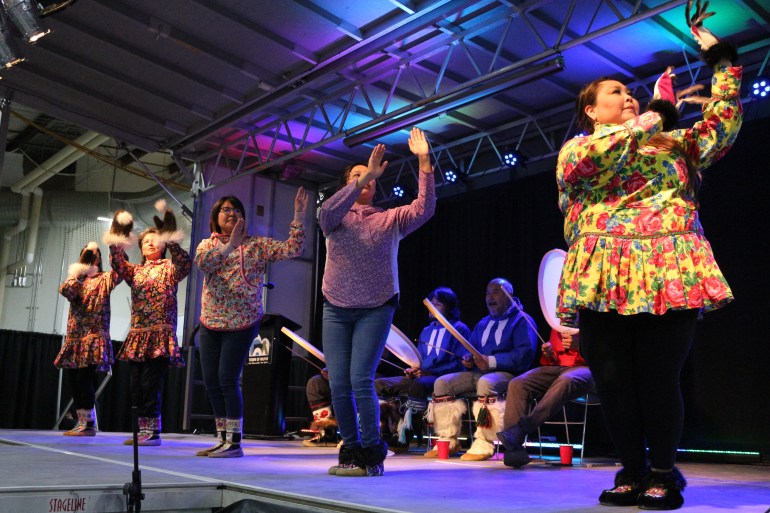
Inuvik’s Great Northern Arts Festival is working to fill a significant funding gap after applications to the Canada Council for the Arts were denied this year.
Festival executive director Adi Scott said the organization had applied for two grants – one to support travel for participating artists and another to cover core festival costs. Together, the applications totalled about $90,000.
According to Scott, both requests were rejected for similar reasons. She said the festival received its lowest score in the “feasibility” category, which ultimately affected its overall ranking.
“I believe that this is a common thing that’s happening across the North,” she told Cabin Radio. “Other organizations I’ve spoken to in Yellowknife have also been denied their funding based on feasibility, but other companies we know in the south have had it approved.”
The outcome came as a surprise to the festival, which has received funding from the council in previous years. Scott said there is no appeal process once decisions are made and organizations have to reapply in future funding cycles.
Advertisement.
Advertisement.
Scott said the funding gap is expected to affect artist participation, particularly for those travelling from isolated or low-income communities. Travel support typically makes up a large portion of the festival’s expenses, she said.
To address the shortfall, the festival is ramping up fundraising efforts and encouraging artists to apply for individual grants. Organizers are also relying on partnerships and in-kind contributions.
At a recent council meeting, the Town of Inuvik approved an in-kind donation of more than $30,000 for the festival. The Gwich’in Tribal Council continues to provide office space, while other regional partners are contributing resources and sponsorships, Scott said.
Airlines and local groups have also donated items such as flight certificates, which will be used for artist travel or fundraising raffles.
Advertisement.
Advertisement.
Scott said the festival remains committed to bringing diverse artists together in the North.
“We’ve pretty regularly got funding from Canada Arts Council in the past, so it was a little surprising to not get any of the funding this year,” she said.
“It is going to make an impact, so we’re going to pull our community together and all our people who support us and make some plans for fundraising instead to make up that gap.”
Council’s own funding reduced
The Canada Council of the Arts says its funding has fluctuated in recent years due to shifting demand, program priorities and federal budget decisions.
A spokesperson for the council said its parliamentary appropriation has been reduced by about $10 million.
The agency distributed roughly $307 million in 2023-24, a figured that dropped to $284 million in 2024-25, which the council said reflects “a combination of the reduced appropriation and carry‑forward adjustments rather than a single policy change.”
“In addition to regular granting, the Council invested $275,000 in 2024-25 to strengthen arts organizations in the territory as part of a multi-year co-delivery partnership with the Government of the NWT,” the spokesperson said in an email.
“This investment, which focused on organizational capacity development, was a complement to ongoing peer‑assessed funding provided to artists, groups, and organizations across the territory.”
Advertisement.
Advertisement.
In the NWT, the council said, overall funding has not declined over the medium term, despite year-to-year variation. Funding increased between 2020 and 2024, the council added, supported in part by temporary pandemic-era programs that have since ended.
“Funding levels were higher during and immediately following the COVID‑19 period, when the Canada Council delivered temporary, time‑limited funding to support the arts sector nationwide,” the email continued.
“As those exceptional measures concluded and the Council returned to its core parliamentary appropriation, annual funding levels adjusted accordingly. Recent decreases should, therefore, be understood in the context of normalization from elevated pandemic‑era funding, rather than as a change in regional priority.”
GNAF ‘hasn’t applied consistently’
The most recent data provided by the council show 16 recipients in the territory received funding in both 2023-24 and 2024-25. Total funding declined slightly to about $740,900 in 2024-25 from $774,800 the previous year.
The council said while Ottawa recently announced $6 million over three years for the sector, it falls short of current needs. The spokesperson said the council continues outreach efforts in the North and plans to take part in the 2026 Arctic Arts Summit.
For festivals and other groups applying for project funding, the council said it is common for results to vary from year to year. Applications are assessed through a “highly competitive” peer-review process, the spokesperson said, and previous funding does not guarantee future support.
The council added that project funding applications are assessed independently in each competition based on published program criteria, relative assessment results, overall demand, and the availability of funds.
“In this case, the festival did not lose funding in the sense of having an existing grant cancelled or reduced. Rather, its application was assessed alongside others in the same competition, and because of the high level of demand and limited funding available, it was unsuccessful in that particular round,” the council said.
“It is also important to note that GNAF has not applied consistently to the same funding opportunities from one year to the next and that this might have also impacted the variation in reults. It is important that applications align closely with the objectives of the funding opportunity being applied to.”
