


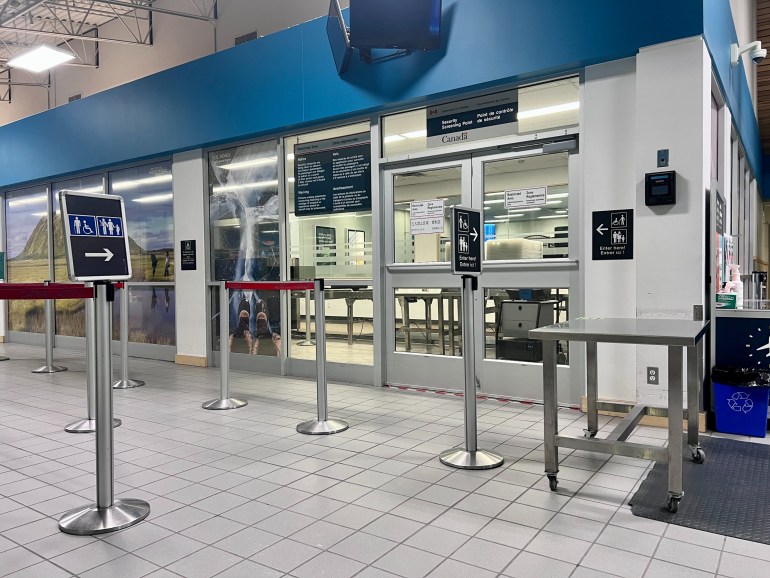
Yellowknife Airport has now formally applied for an upgrade that could significantly speed up the time it takes for passengers to clear security, officials say.
Not all flights departing Yellowknife Airport require security screening. Passengers can walk up to most flights within the NWT without their bags being checked.
However, flights bound for southern destinations do require security – and that can lead to long lines for screening, particularly when multiple airlines’ flights coincide.
In 2024, waits of an hour or more to clear the single-file security line in Yellowknife became frustratingly common for some passengers.
Complaints received by Cabin Radio have subsided a little since, but it’s still possible to find yourself waiting a long time to reach the two gates from which flights to the south depart.
Advertisement.
Advertisement.
At the Northern Air Transport Association’s annual conference late last month, Kevin Dragon – the territorial Department of Infrastructure’s director of air, marine and safety – said the GNWT had applied to the Canadian Air Transport Security Authority for improvements.
Catsa, as the authority is known, is the federal agency responsible for security screening at Canadian airports. (The GNWT can’t simply change the security arrangements itself. Catsa has to do it.)
Dragon told conference attendees the airport has requested Catsa Plus, an upgraded operation that allows more passengers to place their belongings on the belt for screening at the same time, and lets passengers who already know the drill get through more quickly.
The X-ray belt flows faster and the screener watching those X-rays can do the job from elsewhere, rather than having to be seated by the machine. At the end, there’s an “expanded repack zone.”
Advertisement.
Advertisement.
The GNWT has been talking about moving to Catsa Plus at Yellowknife Airport for years, so news of the application doesn’t mean anything will change overnight.
However, Dragon said the impact could be significant if Catsa makes the change.
“Right now, we’re processing 100 passengers per hour,” he said.
“If we move to this new system, we would probably process 240 passengers per hour.”
New federal fund may help
More broadly, Yellowknife Airport is set for major alterations in the coming years as the Department of National Defence rolls out its upgrade of a military installation on the airfield’s southern side.
The passenger terminal could also be replaced in the next decade, Dragon said. Smaller projects like washroom upgrades are taking place this year.
A broader strategic plan for the airport is set to be released soon.
“We’re looking at probably 15 projects over the next 10 years,” said Dragon, “so the Yellowknife Airport is going to be a pretty busy place.”
Advertisement.
Advertisement.
Elsewhere, work is expected to take place on the secondary runway that crosses the main airstrip in Fort Smith.
Inuvik’s runway extension work – also tied to military investment – has been paused to allow work on embankments to settle and the underlying permafrost stabilize.
“We are looking at the Arctic Infrastructure Fund, too,” said Dragon, referring to a new billion-dollar federal fund for northern infrastructure, which has a particular focus on transportation.
“We do have a list of priorities. I can’t really speak too much about it right now, because the federal government loves to make announcements,” he said, “so we want to continue to allow them to have that opportunity.”
NWT Tourism working on luggage issue
At the same conference, NWT Tourism’s Donna Lee Demarcke said the agency is advocating for improvements at Yellowknife Airport and beyond.
Demarcke noted the airport just recorded “the most passenger movement through that terminal in history.”
“We know the department is looking at what a new terminal looks like,” Demarcke said. “We see that it is a very, very busy terminal, and so we’ve been working with the department to see how we can support.”
Beyond that, Demarcke said a big issue NWT Tourism hopes to address is the amount of luggage left behind when people travel north.
Advertisement.
Advertisement.
“Almost all of our visitors are coming here with the full capacity of cargo that they’re allowed to carry on the planes. Luggage is getting left behind on a consistent basis,” she told Nata’s conference.
“When you’re coming for a three or four-night trip and your luggage doesn’t make it, it puts a big damper on your trip.
“We’ve been working with the airlines on this for quite a while, and we’re hoping to have some announcements in that space in the coming weeks.”
