



Advertisement.
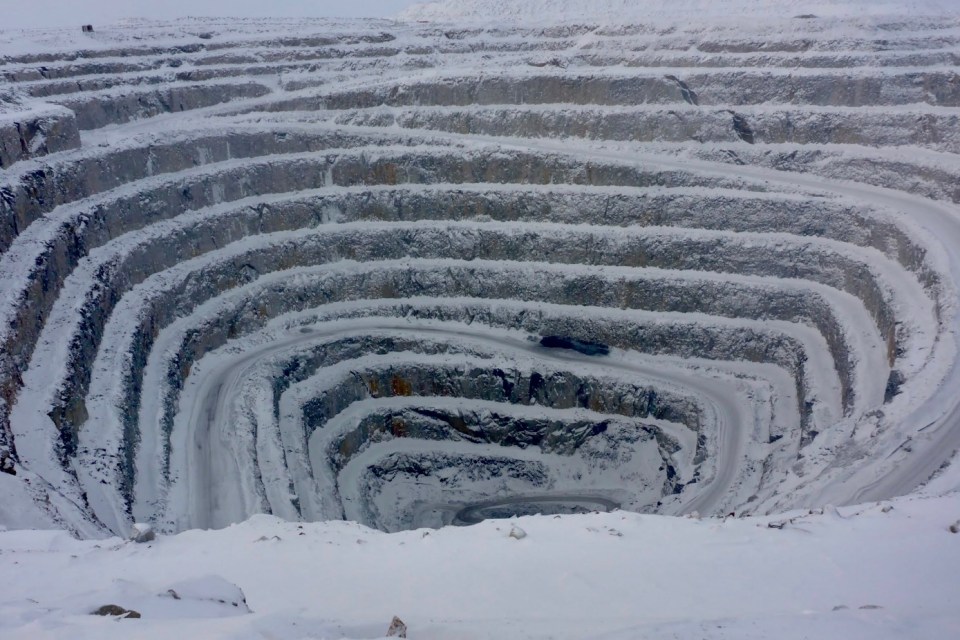
As the owner of the Ekati diamond mine seeks creditor protection, some people are questioning what that will mean for its environmental responsibilities, including reclamation of the site.
Arctic Canadian Diamond Company – or ACDC, a subsidiary of Burgundy Diamond Mines – says it is facing financial troubles amid a difficult natural diamond market, tariffs and other challenges.
It owes at least $380 million to hundreds of creditors, including roughly $10 million to the NWT government.
In court documents, the company estimates it will cost nearly $428 million to reclaim the mine site – and it’s currently around $100 million short.
Advertisement.
Advertisement.
Kevin O’Reilly, a longtime environmental advocate and former NWT MLA, told Cabin Radio he expects it will cost more than that to clean up the diamond mine.
“We cannot hand this back to the feds. So guess who’s going to eat this? The territorial government and us as taxpayers. And that is outrageous,” he said.
“This is a modern mine that was regulated through the co-management system and is going to end up costing the taxpayers of the Northwest Territories hundreds, probably, of millions of dollars. This is mismanagement on a huge scale. This is not what devolution promised and the GNWT has fumbled the ball.”
O’Reilly said he feels the territorial government did not do enough to ensure there was a final closure and reclamation plan in place when Burgundy took over Ekati – and that the company provided enough money to fully fund the eventual cleanup.
Advertisement.
Advertisement.
He said the GNWT has ignored “virtually all” of the recommendations contained in a report on preventing and managing contaminated sites issued by a legislative committee in 2023. In its response to the report, the territory said it fully accepted four recommendations, accepted six more “in principle” and rejected five others.
Don’t mines have to pay for cleanup in advance?
The NWT government and Wek’èezhìi Land and Water Board defended the amount of money they have required ACDC to provide for reclamation, expressing confidence in the territory’s regulatory system.
As a requirement of land and water licences, resource companies must pay security deposits to the GNWT to ensure funds are available for closure and reclamation. That’s meant to prevent the public from having to foot the bill for cleanup if a company abandons a project.
For projects in the territory’s Wek’èezhìi management area, such as Ekati, the Wek’èezhìi Land and Water Board is responsible for approving the amount of security a company must pay.
The board says the GNWT also has an important role to play as it approves licences, decides on the form of security a company can pay, holds onto those funds and is ultimately responsible for covering the costs of cleanup if resource companies are unable to pay.
The land and water board last updated the amount of security required for Ekati in 2023, approving an estimate of more than $311 million, which was provided by the territory. At the time, ACDC had provided an estimate that was approximately $11.5 million lower. (The company’s new estimate in court filings this month is much higher.)
Prior to 2023, the NWT government said it had not reviewed site-wide security for the mine since 2014. The board said it made 12 adjustments to security for Ekati between 2014 and 2022.
The GNWT says it currently holds around $327 million in securities posted by ACDC, including security under the Environmental Agreement for Ekati, which is administered outside the land and water board process.
Advertisement.
Advertisement.
Is the security high enough?
The environmental watchdog for Ekati says that amount will likely not cover the full costs of cleanup.
“If the idea is that polluter pays, if that’s the objective that we’re trying to meet, then yes, the security would likely have to be higher, and considerably higher,” said Marc Casas, executive director of the Independent Environmental Monitoring Agency.
He acknowledged, however, that the GNWT is in a difficult position as it also wants jobs and prosperity.
He added that ACDC is currently seeking a buyer for the mine that could potentially come up with the money for reclamation.
The Wek’èezhìi Land and Water Board and territorial government expressed little concern to Cabin Radio that taxpayers could face cleanup costs for Ekati.
Ryan Fequet, executive director of the board, said that “to the best of everyone’s knowledge,” the security held by the GNWT will cover the full cost of the current interim closure and reclamation plan for Ekati.
He said people should be “comforted” that the security estimate is based on how much it would cost a third party to clean up the site.
“It costs more for a third party to come in and clean up a site than it would cost the company, who has personnel and equipment on site, so they can actually do it for a fraction of the cost,” he said.
Advertisement.
Advertisement.
Fequet said he was not sure where ACDC came up with the higher $428-million number for reclamation it cited in court documents. The NWT government told Cabin Radio it has contacted the company for more information on that figure.
Robert Jenkins, deputy minister of the NWT Department of Environment and Climate Change, said the territory has “a really fulsome process” to estimate securities and the GNWT has confidence in its regulatory regime.
Both Fequet and Jenkins noted the company that previously owned Ekati, Dominion Diamond, was able to successfully find a buyer after facing its own money troubles and seeking creditor protection.
“I think that process is under way now and we’ll have to see how that unfolds,” Jenkins said of ACDC.
Currently, Casas said, the closure and reclamation plan for Ekati “isn’t where it really should be.” He said if the company were to fold and not find a buyer, the GNWT would have to basically rewrite the plan.
“We’ve raised concerns for years now about the urgency to get these closure plans going,” he said. “I think the board is doing their best to try to make them do it, but their current situation is not ideal.”
In 2024, the land and water board rejected ACDC’s submission of an updated interim plan, finding it had not significantly advanced from previous plans and did not meet expectations given the stage of the mine’s life.
ACDC is required to submit a final plan by December 2027. The board said the company’s proposal that it wait until that plan to propose closure criteria was “not acceptable.”
Advertisement.
Advertisement.
Environmental sampling and loans
Beyond closure, Casas said the monitoring board is concerned about what ACDC’s financial situation could mean for environmental monitoring.
“Environmental monitoring is expensive and as they’re trying to reduce their costs, [we] worry that there is a temptation to limit the monitoring as much as you can,” he said.
Casas said the mine did not complete some water sampling last summer and has requested extensions on several reports. He said that could be an issue if it becomes a trend, particularly as such data will help to inform a final closure and reclamation plan.
Jenkins said the creditor protection process does not relieve the mine of its environmental obligations.
Fequet said when Ekati previously went into care and maintenance, it was able to maintain its environmental sampling and reporting responsibilities.
Wildfire evacuations may have affected sampling in 2025 and it’s not unusual for projects to not always complete the full suite of environmental sampling every year, he said, adding that decades of previous data is available.
Earlier this week, ACDC received a new federal loan of up to $60 million – on top of $175 million in other recent federal loans – to continue operations at Ekati.
In court filings, ACDC head of finance Brent Mierau said without the money, the mine would “erode rapidly” and there would be “a risk of significant environmental issues.”
Advertisement.
Advertisement.
In another court document, he described the requirement for companies to provide security to cover total estimated closure costs a “significant financial burden.”
Casas and the NWT government said that is “the cost of doing business” and intended to protect the public.
In response to a request from Cabin Radio, a Burgundy spokesperson said no one was available to comment and instead pointed to a press release from the company about the status of court proceedings.
The release stated the mine will continue operations with a focus on “safety, environmental stewardship and operational continuity.”
Correction: May 20, 2026 – 17:403MT. This article initially stated that prior to 2023, the Wek’èezhìi Land and Water Board had not reviewed the security for Ekati mine since 2014. In fact, it was the GNWT who said they had not reviewed site-wide security for the mine since 2014.
