


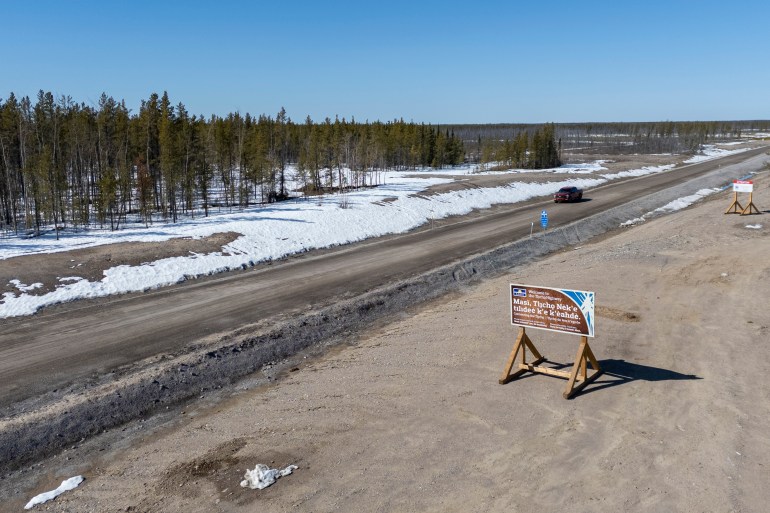
The NWT’s Nico mine took a significant step toward viability on Friday as the federal government said it would provide up to $50 million to help build a spur road.
The money, from a critical minerals fund, will go to a joint venture operated by Fortune Minerals and the Tłı̨chǫ Government.
Fortune calls Nico the largest bismuth deposit in the world and now considers the metal to be mine’s most marketable asset. It would also offer cobalt, gold and copper.

A 51-km spur road from the mine site, northeast of Whatì, to the Tłı̨chǫ Highway is a prerequisite for production to begin.
Advertisement.
Advertisement.
Fortune, which has been trying to open Nico for decades, created its joint venture with the Tłı̨chǫ Government earlier this year for the stated purpose of securing this cash.
“By working collaboratively with Fortune and seeking federal support, we are advancing infrastructure that has the potential to deliver lasting benefits for Tłı̨chǫ Citizens and the broader region,” Tłı̨chǫ Grand Chief Jackson Lafferty said at the time.
On Friday, Fortune boss Robin Goad said the federal funding announcement “helps level the playing field with other jurisdictions.”
Alongside a refinery Fortune plans in Alberta, Goad said the Nico mine can offer a “domestic process solution for cobalt, bismuth, copper and gold to help mitigate critical mineral supply chain vulnerabilities for the metals needed for the energy transition, new technologies and defence.”
Advertisement.
Advertisement.
The company has benefited from renewed American and Canadian interest in accessing critical minerals without having to go through China, which dominates the market for many of them.
Announcing the Nico spur road funding and other investments on Friday, federal energy minister Tim Hodgson said the money would “create good jobs, deliver lasting prosperity for Canadians and position Canada as a supplier of choice in the critical minerals the world is counting on.”
A separate $200,000 grant to the Tłı̨chǫ Government will pay for community engagement and a traditional knowledge study ahead of the Nico spur road’s construction. The North Slave Métis Alliance will receive $141,000 for similar work.
Other northern beneficiaries of funding announced on Friday include the Wekʼèezhìi Renewable Resources Board, which receives $200,000 for “community-based engagement, knowledge gathering and documentation, verification and consensus building regarding the impact of the Arctic Economic and Security Corridor on Bathurst caribou.”
The Deninu Kųę́ First Nation in Fort Resolution receives $188,000 to grow its caribou monitoring program so its members “can better understand how the potential Arctic Economic and Security Corridor and critical minerals development could affect the land, wildlife and community.”
Enterprise railyard owner Cando receives up to $733,000 toward developing “a multimodal logistics hub” at the site. What that actually means wasn’t clear.
