


Advertisement.
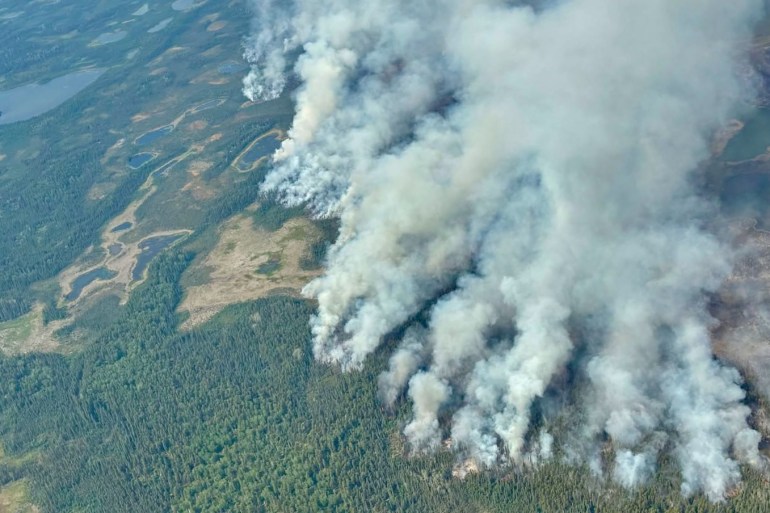
Fort Simpson was ordered to evacuate on Sunday evening because forecast winds could push a wildfire burning seven kilometres away toward the village in the coming days, an official said.
Other factors include the complexity of evacuating Fort Simpson – which requires a ferry or airlift – and the battle to keep the highway to safety clear of other fires.
“The evacuation order was recommended now, tonight, just recognizing that it takes quite a bit of time to evacuate Fort Simpson, since it’s by ferry for anyone driving,” Forrest Tower, an information officer working on the wildfire, told Cabin Radio.
The village had been under an evacuation alert since June 26 and officials had asked residents to prepare for possible evacuation by packing a go bag and getting fuel. Residents were also asked to pre-register for a possible evacuation using a GNWT form.
Advertisement.
Advertisement.
An evacuation order was issued shortly before 7:30pm on Sunday. The weather ahead was a key concern.
In a 4pm forecast, Environment Canada projected a Monday high of 29C for Fort Simpson with a 30-percent chance of showers and risk of a thunderstorm in the late afternoon or evening.
Winds are currently blowing at 15 km/h from the southeast, gusting to 30 km/h, according to an NWT Fire update at 5:30pm on Sunday. But those winds are forecast to potentially shift to come from the southwest, which might send the fire toward the village.
Wildfire FS016 has not meaningfully advanced toward the community since it was detected on June 26, NWT Fire said earlier in the day. Instead, Tower said, the fire has grown “almost parallel” to the community.
Advertisement.
Advertisement.
“The issue isn’t that it’s growing towards the community tonight, it’s that tomorrow – if we do see those winds – there is real potential that it will start moving closer,” said Tower.
Yellowknife is the designated host community for Fort Simpson’s evacuees.
To reach the territorial capital, a seven-hour drive away, evacuees must cross the Liard River by ferry then head east on Highway 1. However, fire FS014 is burning close to Highway 1 while other fires have closed Highway 7.
Tower said fire crews are working to keep Highway 1 open, while another consideration is that firefighters can more easily set up structure protection once residents are safely out of the community.
“The most amount of vehicle traffic and everything that we can get out of the way, if we do need to be in a place of structure protection and defence in the next few days, it just helps all that stuff happen,” he said.
Fort Simpson’s volunteer fire department and Hay River firefighters have set up structure protection in the Wild Rose area, including four portable water tanks, more than a kilometre of hose, and mounted sprinklers on each home along the protection line, according to a Facebook post on Saturday evening.
Tower said areas of the village prioritized for structure protection are based on where the wildfire is likely to hit and where protection would have the most impact. The Wild Rose area was targeted first because it is the closest to the fire with dense trees between houses, he said.
“When we look at wildfire growth in a situation like this, a lot of the concern actually is embers being thrown … and they can be carried several 100 metres, up to a kilometre away,” said Tower.
