


Some of Yellowknife’s cyclists will take part in a Critical Mass Bike Ride to City Hall on Monday, where council will hear presentations about the city’s cycling future.
Anyone who wants to join the ride can meet at Center Ice Plaza at 6pm. Organizers say the group will then “reclaim the roads” with a slow ride down 50 Avenue to City Hall. (The council meeting starts at 7pm.)
The event is among the activities organized for this year’s Earth Week in Yellowknife.
Adam Denley will be taking part in the ride.
You’ll recognize him in part through his bike, a new and eye-catching “reverse trike” that deploys a large cargo container at the front.
Advertisement.
Advertisement.
Ahead of the event, Denley spoke with Cabin Radio about life as a Yellowknife cyclist and whether reliance on a bike for city life north of 60 is getting any easier.
This interview was broadcast on Afternoons at the Cabin on April 18, 2024. The transcript has been lightly edited for clarity.
Ollie Williams: What does a Critical Mass Bike Ride mean?
Adam Denley: It just means we’re going to get as many people as we can together almost like a parade, one continuous stream of people biking all together from one place to another place as a show of support. A show of intent.
Advertisement.
Advertisement.
A show of support and intent for what? What is the message?
Monday is Earth Day. It’s all about active transportation – walking, cycling, taking a bus, forming a cross-city conga line, whatever. Any kind of transportation where you’re moving your body.
We all know the reasons we shouldn’t be driving our cars. That’s been hammered into us. But there’s a ton of reasons we should want to lean hard into active transportation. You’re moving your body, so it’s good for your physical health. It’s also really good for your mental health.
It’s really good for your wallet, because you’re not having to pay to fuel up and warm up a car all the time, and then fix your car when it breaks down to -40C and the power steering line goes.
It’s also pretty good for your community, because there are more people out in the community – you see more people, you get more engaged, the community is safer because there are more eyes out there looking after each other. Active transportation is the way to go, especially in a city like Yellowknife that is right-sized for it.
The objections I tell myself are: as a journalist, what if there’s a fire across town and I need to be there immediately? What if it’s super cold outside? What if I need to go pick up something unexpectedly? How have you overcome internal doubts like that?
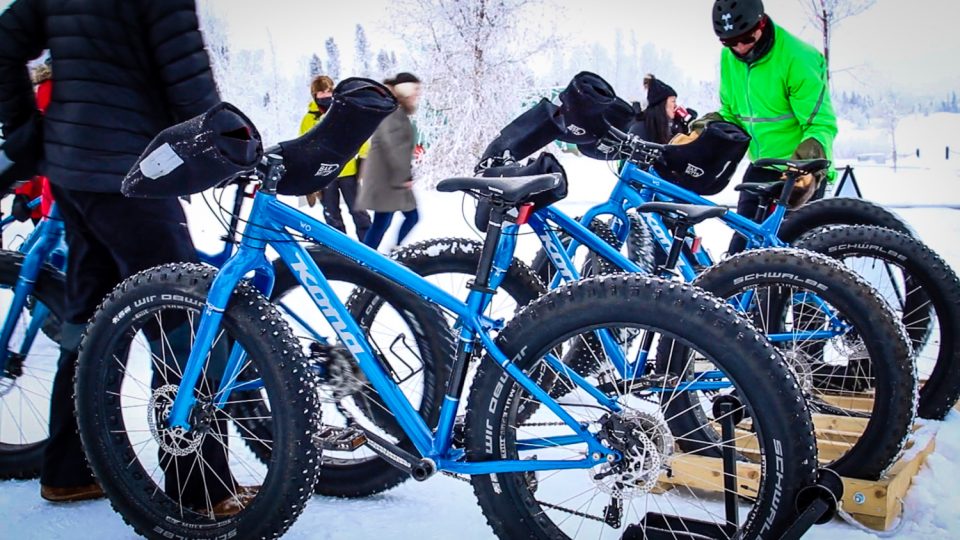
I was living overseas for a time. When I came back, I found out my driver’s licence had expired. So I had no driver’s licence – in December. It was either stay home or ride a bike. There are also some really good technologies for that. There’s one I found – I think it’s Swedish or something – called mee-tins. Or me-tens. Like warm woollen socks, but for your hands. They’re amazing.
Listen, wise guy. I get it. But Yellowknife is at the edge of what is reasonably cyclable in the human experience.
Advertisement.
Advertisement.
Absolutely. But it’s not like that right now, right? If you add up the number of days that are below -40C in a year, or below -30C or -20C, they’re significant but it’s still a small portion of the year. On those days, sure, take the bus. Carpool. If you can’t carpool, go ahead and take your car.
We’re not saying you shouldn’t have a car. I have a little ’06 Ford Ranger and I love it like my third child. But I try to use it for truck things. I’m saying that for your daily transportation needs, a car in this size of town is kind-of overkill.
Coming down from Finlayson to Cabin Radio in a car would take me eight minutes plus a couple of minutes looking for parking. That’s 10 minutes. On a bike, it takes 13 minutes. It only cost me an extra three minutes. I don’t have to search for pay for parking. I get all the other benefits that I already rambled off at the beginning here. The choice to come down here on a bike is not about making a moral choice. It’s just a pragmatic way to travel.
Did you ever have my hang-up of: “Oh, I might need the car for this or that?”
Yes, but there are ways around that. If I go out on my bike, even if I’m not planning on going to the grocery store, I’ll wear a backpack just in case I decide I want to pick something up.
And you’ve also just shown off your bike to me, which is parked outside. It is not your average bike. It’s got the trunk of a Ford Escape welded to the front of it.
It has a big plastic bucket in the front and wheels on either side. It’s a reverse tricycle. It has the steering at the back, so it can make really nice, tight turns.
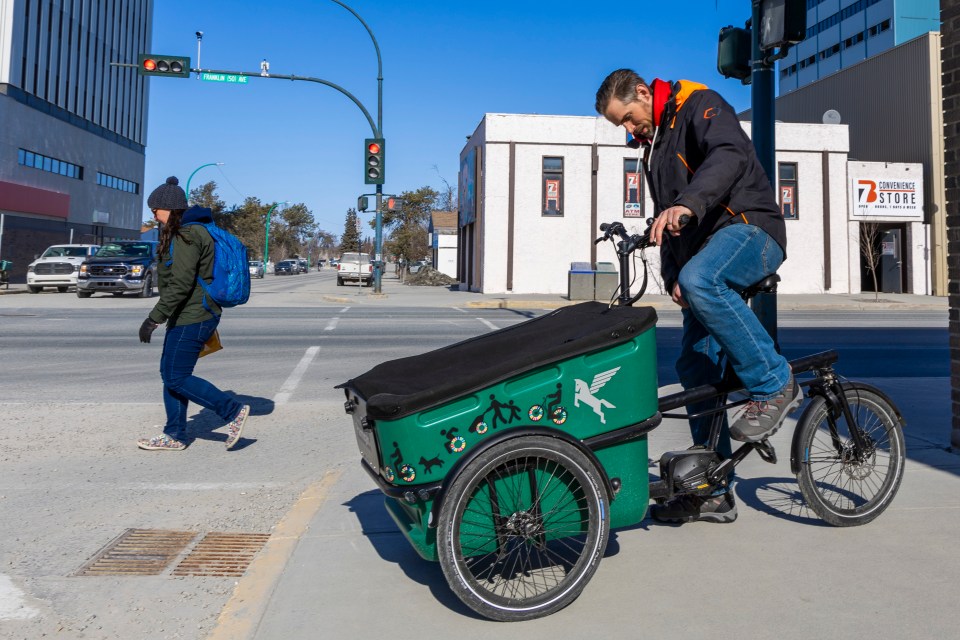
I can get a full load of groceries or I can put my two kids in there. If I’m out at The Black Knight with friends and I’ve got a friend who shouldn’t drive home, I can put him in the bucket and carry him home.
Advertisement.
Advertisement.
The point being, I guess, that much as vehicles these days look different to vehicles when we were growing up, you can now get bikes that do very different jobs to older versions.
There’s a ton of choice out there. If you don’t have the strength to travel around town on your trike, you can get an electric trike that has a throttle so you’re not required to pedal the whole way.
Even compared to an electric car, an electric bike is so much lighter. You’re not paying so much to charge it, there’s not such an investment in the resources that go into the whole thing.
For almost all the trips you’ll do in a year, it’s probably enough. If you’re going to go out and chop firewood, it’s not enough. If it’s deepest, darkest winter and you’ve got to move your whole family over to NACC for a show or something? Again, sure.
Was it expensive to get the right bike for what you needed to do? Does it require a change in philosophy about where you put your money when it comes to transportation?
It does. And it was. There isn’t really a second-hand market for these yet, because they’re new on the scene. If you’re going to buy a cargo bike like that, it is going to be expensive.
Give me a bracket for the budget you’d need.
You could spend anywhere between $5,000 and $12,000 on it.
Advertisement.
Advertisement.
People will have just spat out their coffee at the sound of a $12,000 bike.
Yeah. But you’ve never got to insure it. You’ve never got to put gas in it. If you compare that to purchasing a new vehicle, what’s the least amount of money you could spend on a brand new vehicle. You’d be happy to get away with spending, like, $30,000, right? We’re talking an order of magnitude less for something like this. It has a lower capacity but it also becomes less of a burden for you in all these other ways.
How long have you been biking in Yellowknife?
I moved back to Yellowknife after being away for three or four years. Before I moved away, I biked about never. When I moved away, I was living in a place where we didn’t have a car and so that was just how we travelled around.
Where did you live?
I went to Denmark. The weather is terrible there. It’s always raining, right? It’s raining right now, I would put money on it. But it doesn’t matter, because they’ve made huge investments in the infrastructure and so it’s easy to get around by bike.
In Yellowknife, the city’s working on it – to their credit, they’re really working on it – but we don’t have a fully functional network yet. If you don’t have a safe and comfortable network, people aren’t going to choose it, because you get partway down the network, then it ends and you’re just stuck.
That’s really what this event is about.
Advertisement.
Advertisement.
We’re working in partnership with Ecology North and the NWT Recreation and Parks Association, and we’re going to ride from Center Ice Plaza down to City Hall, we’re going to pop into the council meeting that evening, and we’re just going to say: “We know that you guys want to make these changes. It’s in the strategic vision and all of the policy documents. There’s a community of people that support these changes, and we want you to go ahead with them.”
And for anyone who can’t bear the thought of having to sit through a council meeting, Ecology North’s hosting a free showing of The Lorax.
What are some simple wins to make cycling easier in Yellowknife?
The simplest message would be to prioritize the maintenance of the network of trails and paths that we use for cycling, especially in the wintertime.
It becomes very difficult to travel around when it has snowed and it takes several days before the pathways get cleared, things like that. Or at this time of year, when there are mountains of gravel all over the road that we need to manoeuvre around. It makes it really difficult to do it comfortably and safely.
If they make it a priority – “the first thing we need to do is make sure that our walking and cycling trails are safe” – that would be a huge benefit to people that feel like they can’t rely on this as a mode of transportation.
