


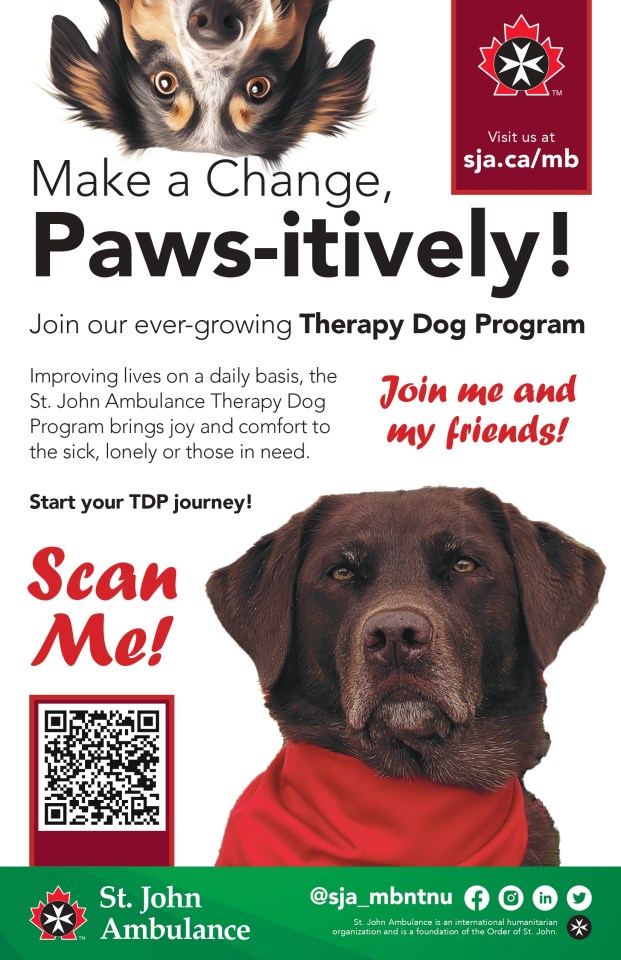
St John Ambulance is looking to expand its volunteer therapy dog program in Yellowknife by recruiting eligible canines.
While the city had around 20 active therapy dogs at one point, coordinator Lisa Urbanski says that dipped after Covid-19 to just two.
Urbanski says the goal now is to get the program, established in Yellowknife in 1993, “back up and running again.”
A recruitment drive is coming up in June.
Therapy dogs visit hospitals, seniors’ residences, nursing homes and other institutions weekly or semi-monthly. In Yellowknife, for example, qualified dogs provide emotional support to seniors at Aven Manor.
Advertisement.
Advertisement.
To participate, dogs must be at least a year old and vaccinated against distemper, parvovirus, adenovirus and rabies.
After an initial online application, therapy dogs and their handlers go through “a series of evaluation tests that simulate a visiting experience in the community,” Urbanski said.
The idea is to mimic a hospital setting and examine dogs for signs of adverse behaviour or anxiety.
“We look for a working relationship with the dog and the handler, so the handler and the dog are a team,” she said.
Advertisement.
Advertisement.
“When they’re doing this work, the handler is the only one that has care and control of the dog … or can hold a leash. We make sure that they have a good relationship and the dog walks well on a leash and listens well.
“We’re not only testing the dog, we’re looking to see the human as well – if they’re a good team together.”
After a fairly simple 12-module evaluation, not every dog goes on to become a therapy dog. During the last session, Urbanski recalled, only two of five dogs were able to secure their uniforms and prepare for visits.
Urbanski said the program has been “phenomenal” in terms of therapy dogs’ impact in the city.
“There’s been situations where people who are non-verbal will say a word,” she said.
“There was a situation at Avens where the dog who visits there could sense when a person was passing away and would go spend time with them.
“Dogs can sense the energy and refuse to leave a room where there’s a person passing away. They really make an impact on people’s lives … We are looking to recruit as many new therapy dog teams as we can during the week we are out.”
The charity also has a reading program at Yellowknife’s public library called Therapy Animals Involved in Literacy Skills – Tails, for short – in which therapy dogs assist children with reading difficulties over six to 10 weeks of sessions.
Evaluations and recruitment of a new therapy dog team will take place in the city on June 11. For questions and answers, go to the St John Ambulance website. For detailed information about Yellowknife recruitment, read this handout.
