



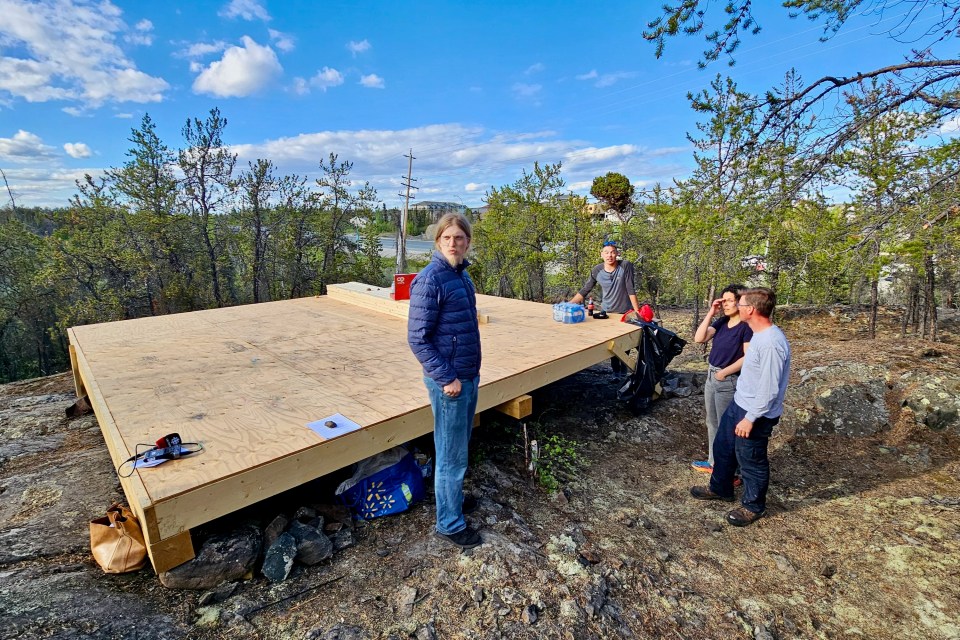
A group of Yellowknife residents is building the foundation of what it calls a tent encampment on a rocky hillside overlooking the territorial legislature.
The residents say they’re challenging the accepted understanding of what it means to offer support to people without homes.
On Friday, the group invited reporters to visit the first wooden pad that has been constructed, where a cabin or wall tent-like structure is expected to appear in the days to come.
More pads and more tents will follow if people experiencing homelessness in Yellowknife adopt the idea.
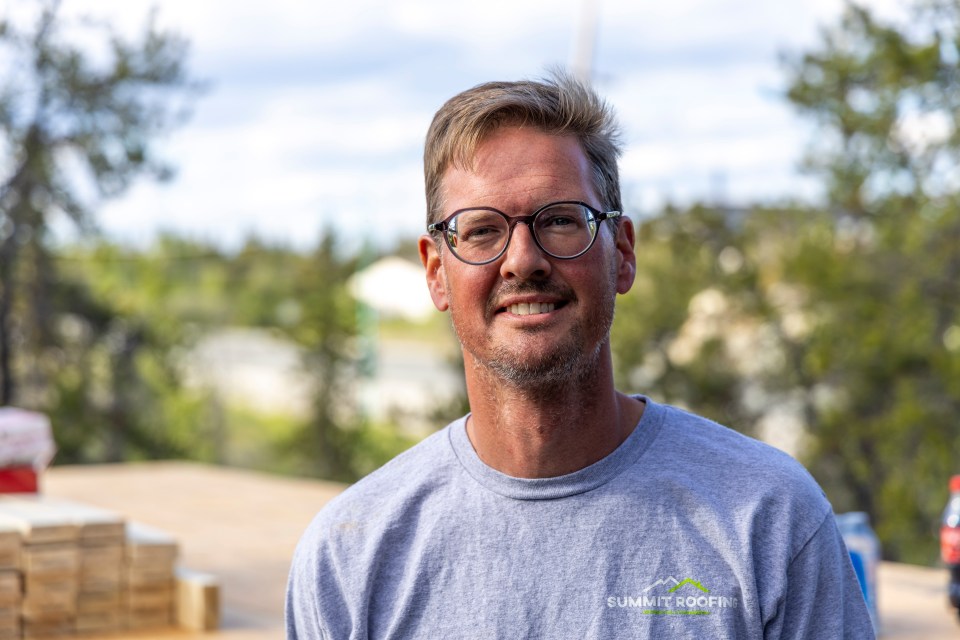
“If I was going to be homeless, this is how I would want to heal. Not at the day shelter or the men’s shelter,” said Dingeman van Bochove, the owner of Summit Roofing, who the group said had donated thousands of dollars in support and who is helping to construct the wooden pads.
Advertisement.
Advertisement.
John Keknek, originally from Gjoa Haven, says he has spent most of the past decade living on the streets of Yellowknife.
“Finally, something is happening,” Keknek said of the wooden pad that had sprung up.
The pad has a view of the road leading into Yellowknife and the city’s luxury Niven housing district sits on the other side. Spin around and the legislature is a short hike away.
Keknek, who was once taught basic roofing techniques by Van Bochove, said he had been thrilled to hear about the encampment and volunteer his time helping at the site.
Advertisement.
Advertisement.
Van Bochove said the plan became a reality quite quickly after an initial two years of slow progress.
“We got together a week ago to keep the momentum going. I was like, ‘Well, I’ve got some time. Let’s go to the lumber store. Let’s just get this going,'” he said.
“On Friday last week we got a bunch of people here to put this together. It took only three hours. Flashmob style, that’s how we did it. We just grabbed people from the day shelter and we had some drinks here, some food, some smokes.”
‘It’s an emergency’
The group’s leading voice is Georgina Franki, a Tłı̨chǫ-language instructor in Yellowknife who says she spent years growing up in a tent herself. (Keknek, similarly, said this lifestyle was not all that different to his childhood on the land south of Gjoa Haven.)
Two years ago, when Franki first had the idea to establish a tent encampment, she said nothing happened because she was by herself. Now, she has support.
She described seeing someone being evicted from a tent by a municipal enforcement officer, an experience that led her to write to City Hall, arguing that the municipality had no choice but to provide a tent encampment otherwise people were being “evicted with nowhere to go.”
“We are not on city property. We are on commissioner’s land,” she said on Friday, “so I’m hoping we will have officials from the government come and support us.”
Franki said she has not yet had any conversation with the territorial government about the idea of forming an encampment of wooden pads, tents, wall tents and possibly cabins near the legislature and a main road.
Advertisement.
Advertisement.
“If the government has a different approach, yes … but for now, it’s an emergency. Everybody’s being evicted to nowhere,” she said.
An act of reconciliation
The government, of course, does have a different approach: shelters and public housing.
Members of the group gathered by the pad on Friday said those things are not getting the job done.
Van Bochove noted recent reports of strained capacity at Yellowknife shelters and nightly violence.
“If I was homeless, I would not want to stay there,” he said.
“Here, you can live a stress-free life. You can wake up on your own terms and work on your healing or your personal growth.”
Keknek said the daily violence at downtown shelters is why he sleeps in a tent rather than staying overnight. It gives him somewhere to go, he said, to get away from things when other people become too much to handle.
Multiple people asked rhetorically whether MLAs at the nearby legislature would opt for a week in some of Yellowknife’s poorest public housing or a week in a tent or cabin on the hillside.
Advertisement.
Advertisement.
“It’s hipster to poop on a composting toilet in the Woodyard. Over there, they would call it hipster. Here, we would call it survival,” said Van Bochove, referring to a lakeside patch of Yellowknife’s Old Town famed and valued for its ramshackle nature.
“This is like an act of reconciliation, taking back what has been taken. Times change. Five years ago, I don’t think we could have done this, but everybody recognizes this is Chief Drygeese territory, so that also put the jurisdiction back to the people it belongs to. That’s why we can do this now.”
GNWT officers ‘following up’
Approached for comment, the territorial government said its officers had “inspected the site and are following up with the person that commissioned the platform to be built.”
“Depending on the nature of the activity within city limits, an authorization may be required from the GNWT and/or the City of Yellowknife. There are regulations that apply to building on public land,” read a written statement from the Department of Executive and Indigenous Affairs.
The department even noted the potential for activity on the wooded hillside to trigger wildfires, adding: “All persons should understand personal and legal responsibilities in preventing wildfires and that you can be held accountable for negligence.”
More broadly, the GNWT said it “acknowledges the growing demand for emergency shelter space in Yellowknife” and was aware that some people either cannot find any space or “do not feel safe accessing shelter services due to this heightened demand.”
“By collaborating with partners such as the City of Yellowknife and organizations serving the homeless population, we aim to better address the complex needs of vulnerable groups,” the territory stated.
“These partnerships allow us to enhance existing supportive and transitional housing initiatives, providing alternatives to an overburdened emergency shelter system.
Advertisement.
Advertisement.
“Our goal is to offer safe spaces where services can be tailored to individual needs, addressing the underlying factors contributing to homelessness in the Northwest Territories.”
‘Indigenous right to occupy’
Franki says the wooden pad is as safe a space as anyone without a home is getting in Yellowknife.
“The importance is safety for themselves, to have a home and to have a good sleep, peacefully,” she said. “Being off the ground a little bit, it gives you a little protection from critters, animals, bugs and whatever. We want to make it like a little home.”
Keknek was so impressed by the first build that he was already scoping out, in his head, where his own wooden pad and cabin might go, if that possibility were to materialize.
Van Bochove suggested building around five structures before the winter would be a good start, then the project would see how things developed. The overarching sense from all group members was of a project that had no real defined goal or end point beyond starting some kind of momentum and conversation, then seeing what happens.
“I do not mind seeing this as a new community. With the supports in place, and the inspiration and guidance of Georgina, this is a place that begins to offer an alternative to the services offered in town, which I just don’t believe in any more after a decade of being in Yellowknife,” said Van Bochove.
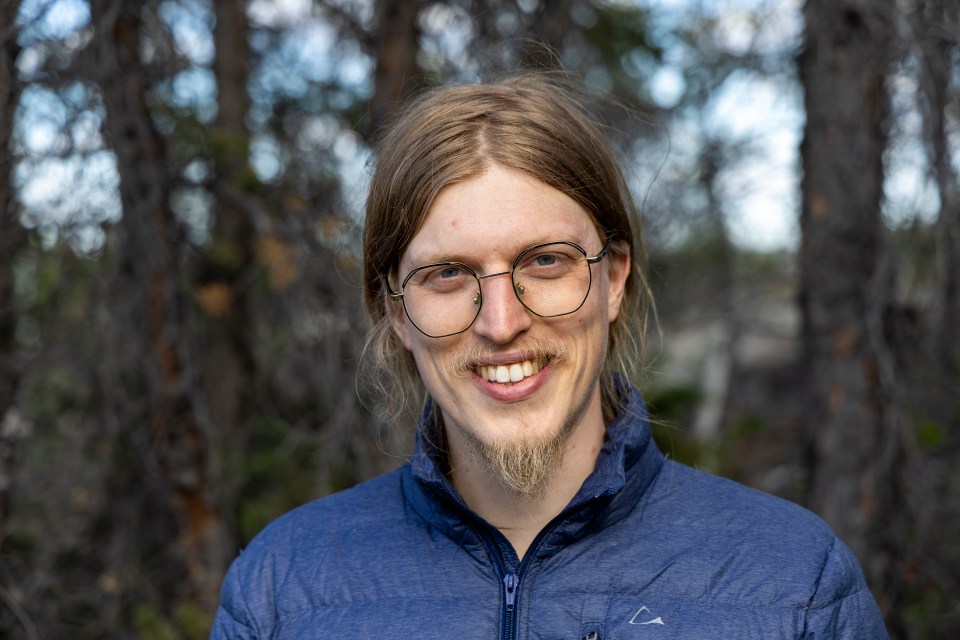
“I like taking a step back and looking at situations that people just accept. Does it need to be this way?” asked Fraser Fuite, another of the group’s members. Franki is his Tłı̨chǫ teacher.
“This is the right to housing we’re talking about,” said Fuite.
Advertisement.
Advertisement.
“Not only that, this is Indigenous land, public Indigenous land. I really think there is an Indigenous right to occupy the land that Indigenous people have had since time immemorial.
“I think that is a strong argument that I hope levels of government will respect.”
Emily Blake contributed reporting.
