


Advertisement.
The Délı̨nę Got’ı̨nę Government, or DGG, is exploring whether a hydro project on the Great Bear River could someday provide affordable power for the community.
Work to understand whether the project should go ahead is at an early stage.
According to regulatory documents filed earlier in January, the DGG has contracted a consulting company to perform geotechnical drilling in the coming months as part of a feasibility study for the Délı̨nę Low-Head Hydropower Project.
Ɂekw’ahtı̨dǝ́ Danny Gaudet, leader of the DGG, said the Sahtu community is exploring the possibility of a hydro project due to the cost of power.
Advertisement.
Advertisement.
For decades, Délı̨nę has considered hydro in some shape or form. For example, a draft NWT Hydro Strategy in 2008 proposed a $600-million, 120-megawatt hydro project on the Great Bear River, with potential transmission lines running between Délı̨nę and Tulita.
By 2013, the Délı̨nę Land Corporation was discussing a smaller-scale project that would have cost up to $40 million and generated about one megawatt, which the corporation said at the time would be enough to meet Délı̨nę’s needs.
Low-head hydro refers to hydroelectric power where the “head” – the vertical height between the hydro water intake and output – is less than 20 metres.
Compared to conventional hydro projects, which usually involve a waterfall or dam, low-head hydro can have a lower cost and environmental impact. Low-head, small-scale hydropower produced from a river is often called “run-of-the-river” hydro and typically generate less than five megawatts of power.
Advertisement.
Advertisement.
When Délı̨nę first considered low-head hydro, Gaudet said, “there was no technology that existed to allow us to do it back then, so we kind-of just put it on a shelf.”
Now, the DGG is thinking about it again due to “the high cost of fuel, our dependency on fossil fuels and no control of prices, [and] the cost of people to heat their homes going through the roof,” Gaudet said.
That prompted the DGG to meet with engineers to find out whether the technology had changed. The answer was yes, Gaudet said, so “we started the studies again to look at it and see what we can come up with.”
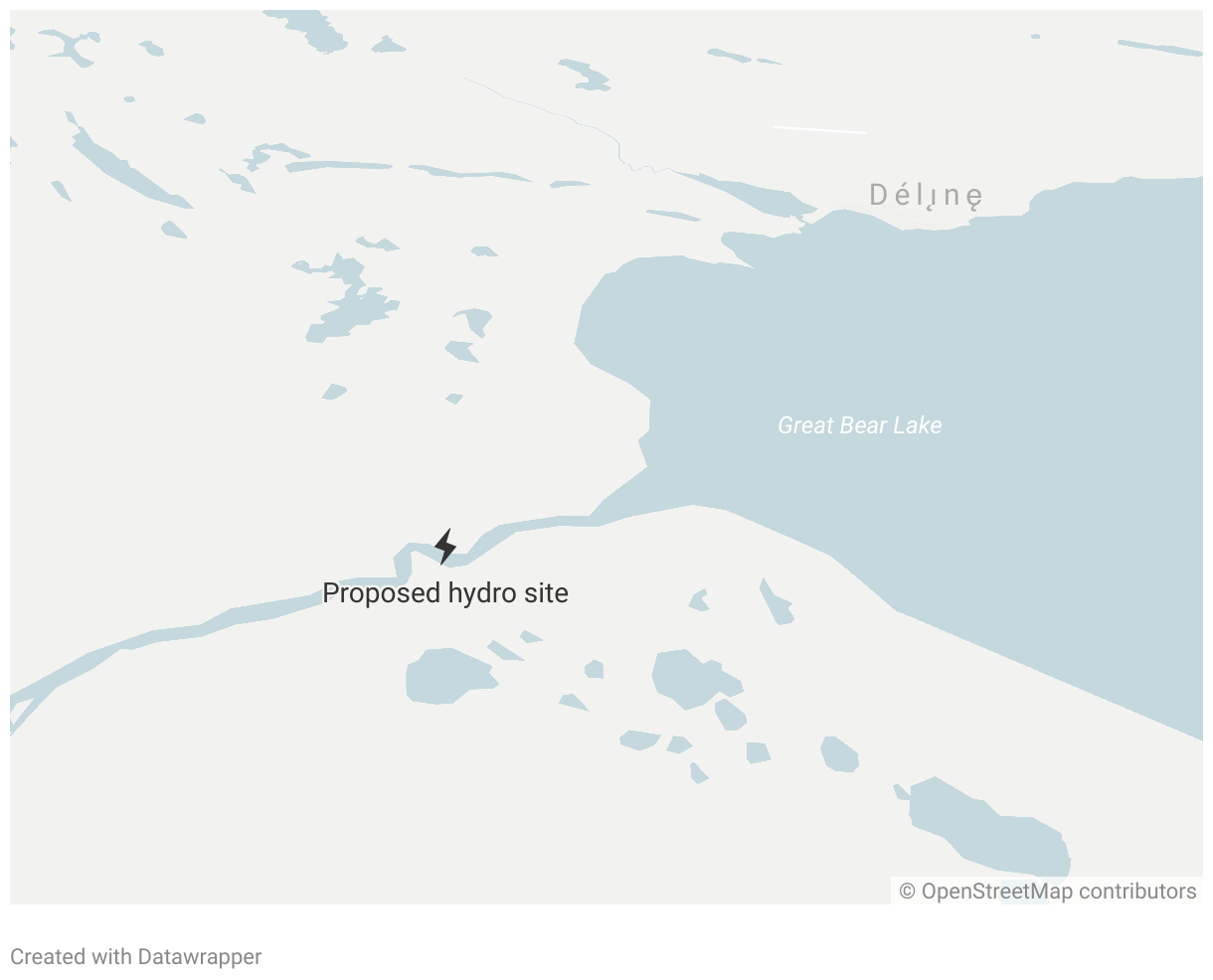
The geotechnical investigation will take place to the southwest of Délı̨nę along the Great Bear River. It involves drilling boreholes up to a depth of 30 metres to determine the presence and thickness of permafrost.
The feasibility study is a first step in bringing hydro power to Délı̨nę. If all goes well, Gaudet said, the project could provide cheap power for the community. He said the DGG would like to eventually get to a point where it can provide power to residents for free.
Currently, all of the community’s power comes from the NWT Power Corporation using diesel fuel. “That’s costing, you know, an average of $1,000 a month to heat the houses in the winter,” Gaudet said. Potentially, he said, people could heat their homes with electricity drawn from a hydro plant instead of diesel fuel.
Hydro could also help heat DGG buildings and reduce its own costs, he added.
“We thought, if this works, maybe it’s a little business that we can do on the side for other communities that have similar rivers and similar issues,” Gaudet said. “It’s something that we may pursue. It might just stop with us … but until we get our reports, we don’t know what the decisions will be.”
Gaudet hopes to get those reports from the feasibility study by the end of the fiscal year, in March.
According to the project’s engagement plan, also published to the public registry, a project update for community members is scheduled for this fall.
