



A deal that gives the Sahtu Dene and Métis of Norman Wells self-government has crossed its final hurdle.
Voters have ratified a final self-government agreement and constitution for the Tłegǫ́hłı̨ Got’įnę Government, formerly the Norman Wells Land Corporation.
Adult Norman Wells participants under the Sahtu Dene and Metis Comprehensive Land Claim Agreement had the right to vote, and could do so via mail-in ballot or in person. Polling stations were set up on Monday in Norman Wells, Yellowknife and Edmonton.
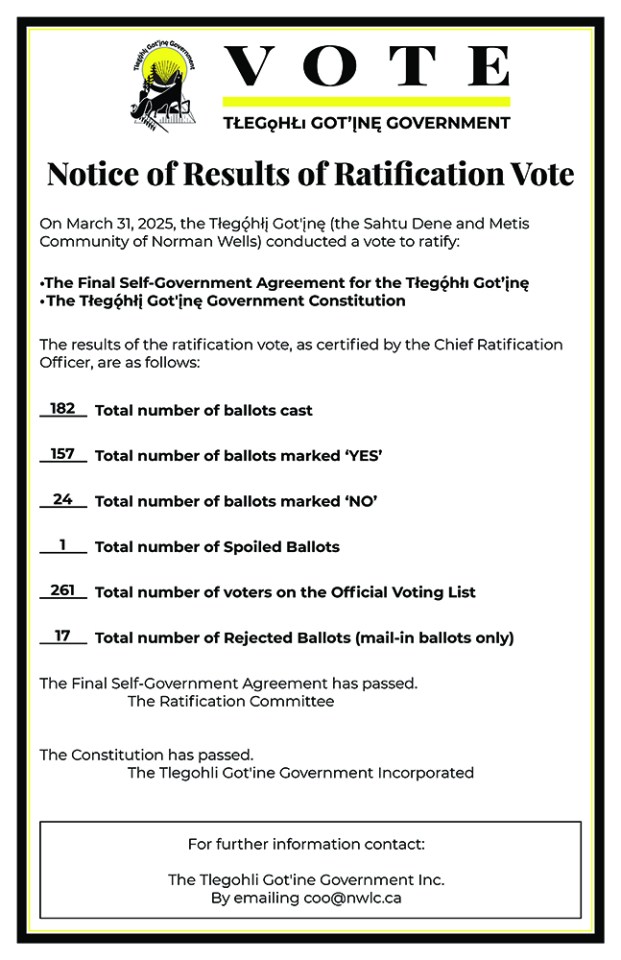
Officials said there were 261 eligible voters. For the agreement to be ratified, more than half of those people had to vote and then more than half of those voting had to vote ‘yes’.
A statement of results published on a website dedicated to the vote declared that 182 people had voted and of those, 157 voted ‘yes’ – meeting both criteria. Twenty-four people voted no.
Advertisement.
Advertisement.
The agreement will now be made legally binding through territorial and federal legislation. That agreement gives the pronunciation of Tłegǫ́hłı̨ as “T’le-go-tlee.”
Negotiations toward the agreement began in 2007. An agreement-in-principle was signed in 2019 and a draft final agreement produced in November last year.
The agreement creates a legislative council with an elected president and eight council members, according to presentations shown at information sessions prior to the vote.
Eventually, as capacity allows, the agreement gives the TGG control over areas like language, traditional healing, education, child and family services, social housing and justice.
Advertisement.
Advertisement.
The TGG will not govern the Town of Norman Wells, which remains a fully separate entity. However, a provision exists allowing the TGG to replace the town government – and assume its municipal-level responsibilities – if TGG members ever represent 70 percent or more of Norman Wells’ population.
(That threshold isn’t particularly close right now. Norman Wells had a population of 698 as of July 2024, of which 402 were non-Indigenous. Not every Indigenous resident is a TGG member.)
While the town and TGG co-exist, the town will be obliged to consult with the TGG on municipal policies and bylaws. The TGG can “force consultation with the GNWT and GNWT can disallow the offending bylaw” in some circumstances.
The elected TGG president must reside in Norman Wells.
Advocates for self-government had said the existing land corporation was not a Treaty Indian Band and was, instead, a simple not-for-profit corporation that could not receive per-capita funding “to operate like a First Nation.”
They argued self-government would offer “a clearer representation of who you are” to members, alongside the right to make laws, receive core governance funding and create programs and services.
At information sessions, voters were told Canada had agreed to provide a minimum of $4.6 million in annual funding to the TGG if the agreement was ratified, subject to review every five to seven years.
A one-year transition period is expected to follow ratification of the deal, involving the creation of new TGG laws for things like financial administration and elections.
Advertisement.
Advertisement.
More: Read a 23-page “plain language summary” of the agreement
More: Read the TGG’s constitution
Self-government agreements have been or are being negotiated with each of the five communities in the NWT’s Sahtu region, as is required under the Sahtu Dene and Métis Comprehensive Land Claim Agreement.
Délı̨nę’s final self-government agreement became effective on September 1, 2016.
NWT Premier RJ Simpson previously said self-government for the TGG was “a vital step in advancing reconciliation and ensuring that Indigenous peoples have the tools and resources to govern in a way that reflects their priorities and aspirations.”
Not all voting members expressed support for self-government prior to the vote.
In emails seen by Cabin Radio, at least one member alleged – among other concerns – that the information sessions had appeared weighted in favour of ratification.
Other beneficiaries with longstanding concerns about the activities of land corporations in the Sahtu, like Walter Blondin, said they needed “good governance assurances” to be prepared to vote for ratification.
The TGG itself, through social channels that still bear the Norman Wells Land Corporation name, had made its position clear, urging voters to back ratification.
Advertisement.
Advertisement.
“Self-government is what we should have been granted in 1919 when the treaty was signed. This is history in the making,” the corporation stated last month.
“We now have a chance to govern ourselves and take back some of our inherent rights.”
President Sherry Hodgson of the Tłegǫ́hłı̨ Got’įnę Government was travelling and not available for comment on Tuesday. Hogdson said she would be available to speak about the results later in the week.
When the draft final agreement was made public, Hodgson called it “another very important milestone for the Tłegǫ́hłı̨ Got’įnę on our more than 100-year journey toward recognition of our inherent right of self-determination and the rejuvenation of our ancestral self-government.”
