



“Knud Rasmussen was the kind of guy Yellowknife needed. That’s because he was good at blowing it up.”
So began a 2013 profile of Knud Rasmussen, who has passed away at the age of 84.
Knud’s blasting literally shaped downtown Yellowknife, while his work in mining and prospecting earned him a place as a chamber of mines honorary member.
A man obsessed with his job, some details of Knud’s life remained such a mystery that even now, his family struggles to fully articulate how he came to leave Denmark for Yellowknife in 1959.
“The work was his life, and it is with me. I guess that’s why we got together,” said Dave Nickerson, another mining hall-of-famer who worked extensively with Knud. “We got along well together because we both thought the same way.”
“He struck me as somebody that was out there making it happen,” said Soren Thomassen, a fellow Dane drawn to the North, “instead of wondering what was going to happen.”
Knud was, in many respects, the classic image of a 1960s and 1970s Yellowknifer. His was a name known by virtually every resident, he took his meals at the Gold Range with the movers and shakers of the day, and he was at the heart of the industry that powered Yellowknife at the time.
More than anything, he prided himself on his blasting safety record. But he had some other talents up his sleeve – or packed onto his back.
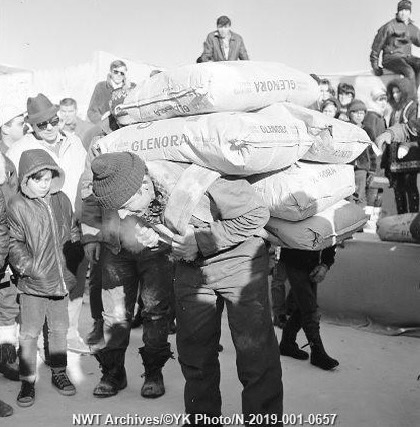
“Everybody remembers that time,” said Nickerson of a contest at Yellowknife’s annual Caribou Carnival in which people would competitively load flour sacks onto their backs. The Rasmussen family says Knud’s record, set in 1969, was 1,000 lb carried for 50 feet.
“He packed an unbelievable load of sacks of flour on his back,” Nickerson added. “He was quite proud of his accomplishment.”
Knud died peacefully on March 31 at his home in Gillies Bay, on British Columbia’s Texada Island, to which he had retired.
A memorial service will be held at the Texada United Church on June 7, followed by a reception at the community’s Royal Canadian Legion.
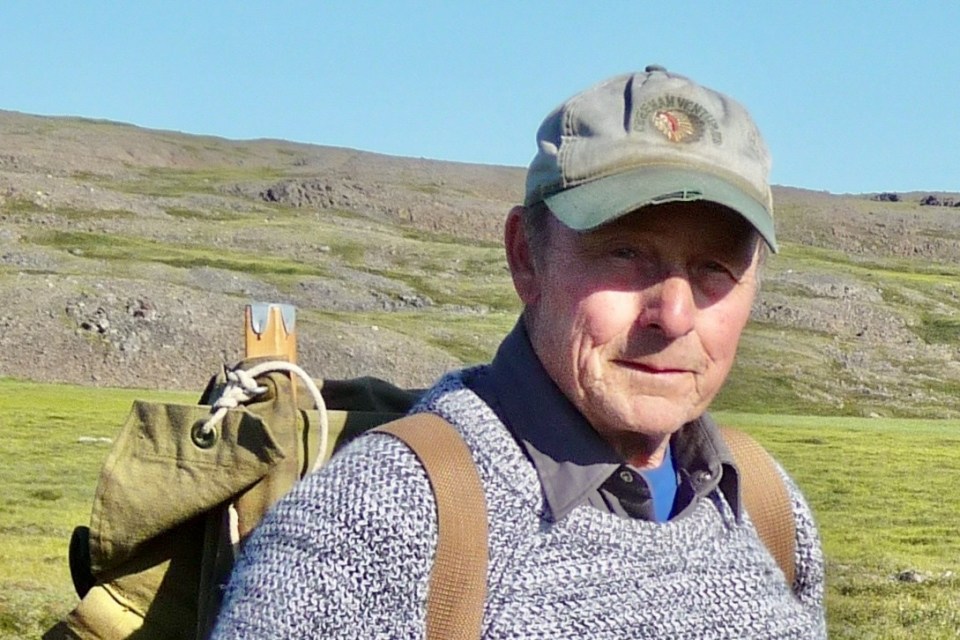
Knud Rasmussen, named in honour of a polar explorer and anthropologist, was born on January 27, 1941 in Lyngby, Denmark to Else and Henrik Eduard Rasmussen.
His son, Will, heard next to nothing about Knud’s childhood in Denmark aside from some tales about his father’s bad behaviour.
“I would hear things like when he was a kid, he was a troublesome student and got kicked out of school quite a bit. Which for me was odd, because my dad was very reserved and quiet and respectful,” said Will.
As an example, Knud is said to have gleefully stranded his little brother up a tree in a schoolyard. In another tale, young Knud connects a farm’s electric fence to the school bike rack with predictable results.
This is not the Knud most Yellowknifers would recognize. By the age of 18 he had boarded an ocean liner, agreed to try his hand at farming in the Northwest Territories, and cut virtually every tie with Denmark.
Instead, the Knud that arrived in Yellowknife was diligent and determined, if poorly adapted to being someone else’s employee.
“He could not work for other people,” said Will.
“When he worked for Giant Mine, it was with the goal of learning how to drill and blast. As soon as he learned how to drill and blast, after a few years, he quit the mine and scraped up enough money to buy his own air compressor and his own drill, and went to business.”
That business turned up in some momentous endeavours.
Knud can lay claim to blasting large portions of downtown Yellowknife – including, his family asserts, the vault of the CIBC bank – as well as work at Con Mine’s Robertson shaft and at Snap Lake, which would become a short-lived diamond mine, in its early days of exploration.
For a hobby, Knud mined and explored some more in a series of personal projects.
Knud had a small shaft at Cassidy Point, which Will understands proved lucrative enough that it enabled him to buy land at Negus Point in the southeast corner of Yellowknife, on the shore of Great Slave Lake. That’s where the family lived, and the road leading to Negus Point is now named Rasmussen Road in his honour.
Thomassen, a mechanic, ended up living at Negus Point, too.
“He’s Danish and so am I, so we hit it off. He offered me a job because he had different pieces of equipment that needed to be not only looked after, but also needed an operator for them,” said Thomassen.
“He was a good man. Everybody that had contact with him respected him, and I ain’t never seen anybody work as hard as him.”
Famously among friends, Knud maintained that throughout his entire career of drilling and blasting, he had only one incident and no insurance claim – even if relatives, with a smile, maintain there were many times in his life that “he could and should have died.”
“He was a very good operator and very, very careful,” said Nickerson. “He had an extremely good reputation for doing good work a fair price.”
Knud married Rita Marie Daniels in 1963 and the couple had three children together before Rita passed away in 1971.
Nine years later, he married Roxanna Lea Raltson. According to family lore, he romanced her with a bottle of Gammel Dansk, a Danish liqueur.
“My mom said their honeymoon was a trip out to Vee Lake with a six-pack of beer,” said Will.
Each with a fiercely independent streak, their relationship somehow worked, even when Roxanna headed south to Calgary with children Will and Kirsten so Will could receive help for a learning disability. The kids would return to see – and work with – their father each summer.
As for the Gammel Dansk, that was about as Danish as Knud got after his move to Canada, despite his obvious accent.
He would let his guard down just twice a year for special dinners with Yellowknife’s small Danish community, and the only Danish anyone heard in the house was when his brother Fritz phoned.
For Will, seeing his dad as a kid often meant working alongside him.
“A lot of how I knew my dad was through work. He spent most of his time working, and he would take my sister and myself along to the job sites or to the mines,” Will said.
Will’s wife, Beth, got to know Knud over the past seven years and sees that slightly differently.
“He’d have a project for Will, but I think it was more of a way to spend time with Will than just get a project done,” Beth said.
“He thought a lot of his family, and I think how he showed he loved them was he wanted to provide for them.”
Beth recalled her surprise and delight when she finally met Knud in person – just two days before her marriage to Will – and received a hug from a man she had been assured was “not a hugger.”
Even so, despite having theoretically retired to Texada Island, Beth could see Knud “always had to be doing something.”
“The man could not sit still. He just couldn’t,” she said.
That’s how ultralight aircraft entered his life.
Perhaps his one true hobby, flying became a passion for Knud when a gentleman in Kam Lake let him try an ultralight in the 1990s. Knud was so thrilled that he rapidly acquired a licence, returned to the man and bought the very same ultralight.
Soon, he was flying his ultralight out to Dome Lake, where he had a cabin and a little mine of his own – all of Knud’s driving forces in one place.
“One of the last things he did before he passed is a friend of his took him out flying on Texada Island, and so he got to spend his final days flying around,” said Will.
“My dad, in a lot of ways, was very blessed. He had a unique vision and passion for what he wanted in life.”
Knud leaves behind Roxanna, five children and six grandchildren. He was cremated at Stubberfield Funeral Home in BC’s Powell River.
In lieu of flowers, his family said, people should consider a donation to their charity of choice.
