


A new study reveals more about the extent of arsenic contamination and its impacts during the early years of gold mining in Yellowknife – and how officials responded.
Authors of the paper, published earlier this month, combed through hundreds of archival government documents related to operations at the Giant and Con mines from 1949 to 1956.
Among the pages were more than 800 measurements of arsenic concentrations from water sources in the area.
Compiling that data, researchers found “extreme and widespread” arsenic contamination of local water bodies from mining operations.
“The biggest takeaway is just the scale of impact of those early years of mining operations,” said study lead author Michael Palmer, manager of the Aurora Research Institute’s North Slave Research Centre.
Advertisement.
Advertisement.
“It’s just a reminder that those early years of operations had a massive impact on the landscape around Yellowknife.”
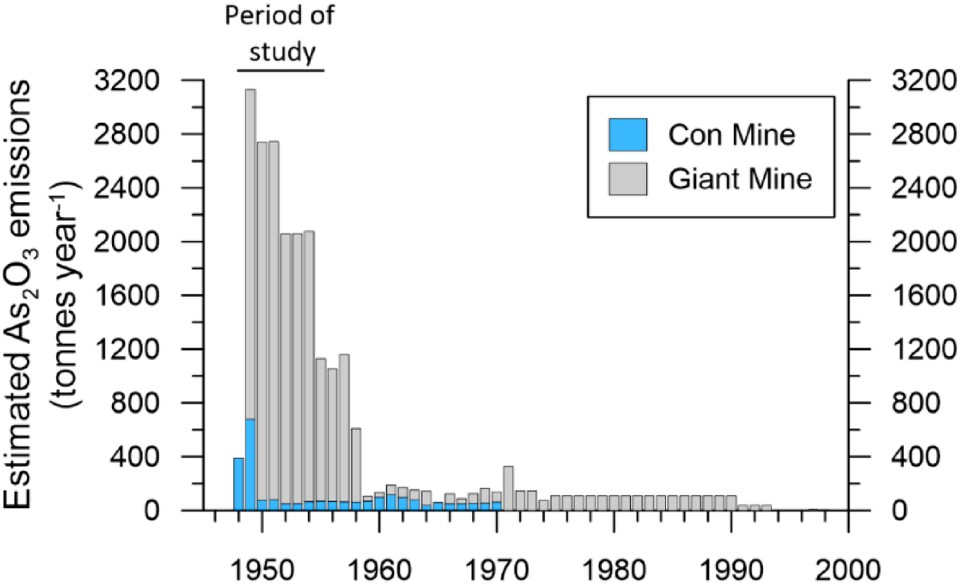
Palmer said the first 10 years of mining operations were responsible for the bulk of arsenic emissions, with more than 86 percent of all arsenic trioxide emissions released prior to 1958.
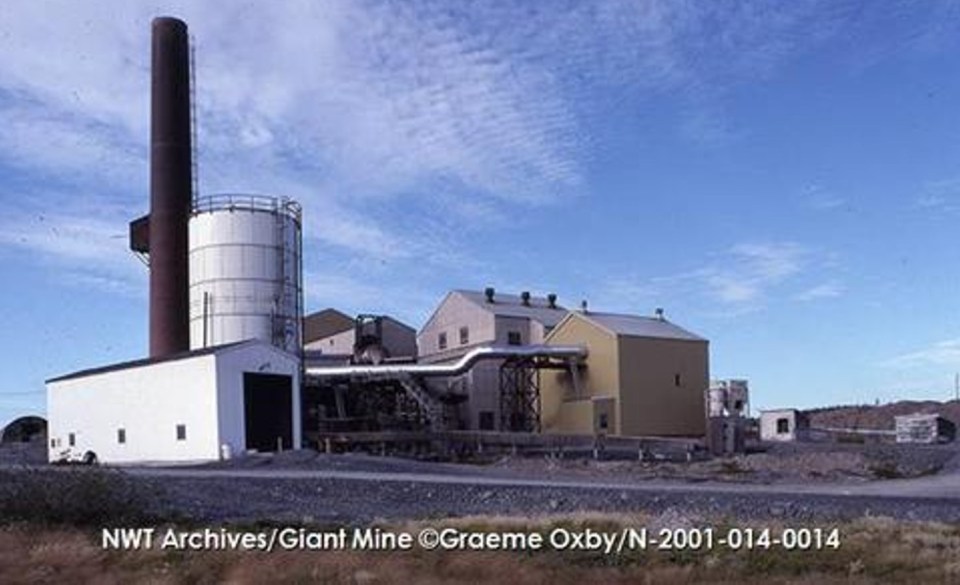
Over its lifetime, Giant Mine released more than 20,000 tonnes of highly toxic arsenic trioxide into the atmosphere, a byproduct of roasting gold ore. That contaminant then landed on the surrounding land and water. While the mine began roasting operations in 1949, pollution controls were not installed until late 1951.
Con Mine also operated a roaster but its total emissions were relatively small compared to Giant. Con installed environmental controls in 1949, reducing emissions by 95 percent.
Advertisement.
Advertisement.
Early on, there was little environmental control of mine tailings at either mine. Tailings were directly discharged into local lakes before tailings ponds were eventually constructed.
Arsenic contamination of water
According to the research paper, during the period studied, median arsenic concentrations from samples of drinking water at Con, Giant and the Yellowknife townsite were 10, 16 and 20 micrograms per litre (µg L−1) respectively.
Current Canadian and international health guidelines list 10 µg L−1 as the maximum allowable concentration of arsenic in drinking water. The US Public Health Service drinking water standard referenced at the time was 50 µg L−1.
Looking at lakes that directly received mine waste, researchers found the highest arsenic concentrations were reported in Pud Lake. Measurements taken from that small lake on the Con Mine property between 1949 and 1956 ranged between 200 and 47,000 µg L−1.
Kam Lake, a publicly accessible lake that received drainage from Pud Lake, also had very high surface water concentrations of arsenic during the study period, between 50 and 4,936 µg L−1.
Meanwhile, arsenic concentrations recorded for Baker Creek, which runs through the Giant Mine site, were between 230 and 980 µg L−1, while measurements were between five and 125 µg L−1 for Yellowknife Bay.
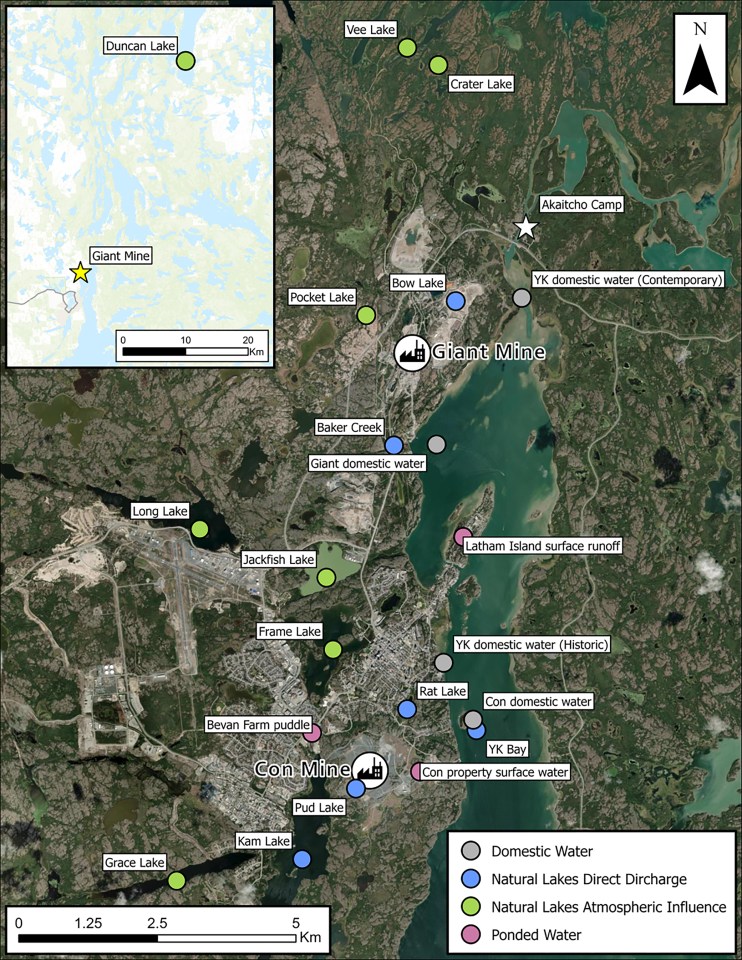
Water sampling records showed many lakes had high levels of contamination solely from atmospheric mining emissions.
Arsenic concentrations were especially high – between 50 to 4,500 µg L−1 – in lakes located within five kilometres of the roaster at Giant Mine.
Advertisement.
Advertisement.
The highest concentrations were recorded in Pocket Lake, a small headwater lake located approximately a kilometre from Giant’s roaster stack, at between 1,850 to 4,500 µg L−1.
Lakes that were used recreationally also showed high median arsenic concentrations, such as 450 µg L−1 at Frame Lake, 405 µg L−1 at Jackfish Lake and 190 µg L−1 at Long Lake.
Impact and response
The report captures observations from archival correspondence of this pollution’s impact on people and wildlife in the Yellowknife area.
Arsenic poisoning of livestock and wildlife was reported as early as 1949, including the death of six cows on a farm near Con Mine after drinking contaminated water and observations of dogs with mouth ulcers, hair loss and gastro-intestinal disturbances.
The first cases of arsenic poisoning involving humans were documented just a few weeks after ore roasting operations began at Giant. In February 1949, two men were hospitalized after drinking snowmelt water while working at the Akaitcho camp, 1.5 km north of the mine.
Most tragically, a two-year old Dene boy died of arsenic poisoning in May 1951. His death was associated with drinking snowmelt water from Latham Island.
Despite early evidence of the environmental and public health risks, government and industry failed to stop arsenic emissions.
Following a meeting of federal officials in May 1949, the Canadian government recommended that ore roasting be stopped until adequate collection procedures were installed.
Advertisement.
Advertisement.
“In my opinion, the situation at Yellowknife should not be permitted to continue any longer,” a memo states.
“Roasting should be stopped and flotation concentration stockpiled until these companies have installed the equipment necessary to prevent further environmental pollution.”
That recommendation was not approved by the Northwest Territories Council.
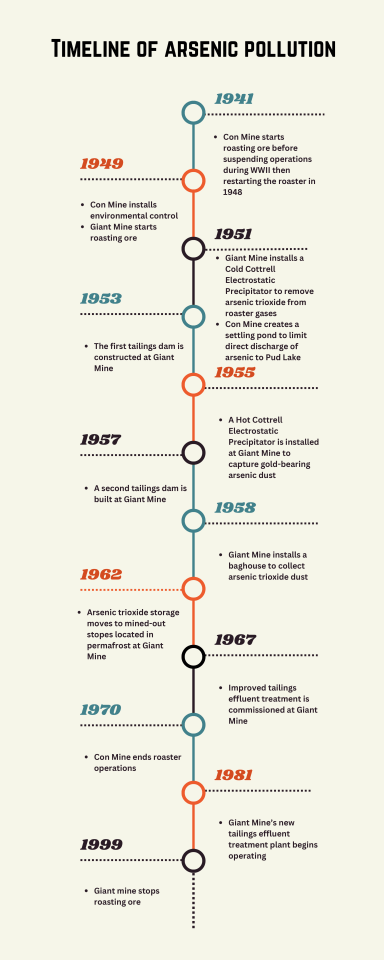
In early 1950, the Northwest Territories Council, Con and Giant did agree to speed up the installation of emissions mitigation technologies.
That same year, health officials issued messages warning residents not to use snowmelt as drinking water.
Palmer said correspondence indicates officials at Giant were waiting to see how well pollution control methods worked at Con before they implemented them.
“In 1949, 1951, it was really hard to get stuff here and so, instead of shutting down the roasting, they kept roasting while they were ordering this material and trying to implement it,” he said.
Present day
Beyond showing historical pollution, the study provides a picture of how Yellowknife lakes have recovered from arsenic contamination over time.
Advertisement.
Advertisement.
Researchers compared data for nine local water bodies collected from 1949 to 1956 with surface water arsenic concentrations recorded between 2010 and 2023.
Palmer said the results indicate different types of lakes recover faster than others.
“Lakes that are well connected to other lakes, that have a clean water source above them, tend to recover a lot faster,” he said.
For example, Yellowknife Bay is on average about 42 times better than it was in the 1940s and 1950s, Palmer said.
Meanwhile, arsenic concentrations in Grace Lake and Kam Lake have reduced about eight-fold. Concentrations in Pocket Lake, Baker Creek and Frame Lake have decreased 2.5-fold, 2.6-fold and 3.7-fold respectively.
“We know that for the most part, there’s not a huge risk to the population of Yellowknife right now,” Palmer said.

The study’s authors said they hope the research will support reconciliation efforts between the federal and territorial governments and Indigenous people.
The Yellowknives Dene First Nation is negotiating an apology and compensation from the federal government for the long-term environmental, social and cultural impacts of Giant Mine.
Advertisement.
Advertisement.
“We thought that this information would provide really important information on the scale of impact during that period, when so many of those impacts were felt to their members,” Palmer said.
Canada has signed economic benefits agreements related to the remediation of Giant Mine with the Yellowknives Dene First Nation, Tłı̨chǫ Government and North Slave Métis Alliance.
The remediation project is expected to cost more than $4 billion and take until 2038 to complete, save for the long-term management of 237,000 tonnes of arsenic trioxide stored underground.
