



Advertisement.
The City of Yellowknife is proposing to rezone parcels of land in the Willow Flats neighbourhood to allow for residential intensification to infill green space.
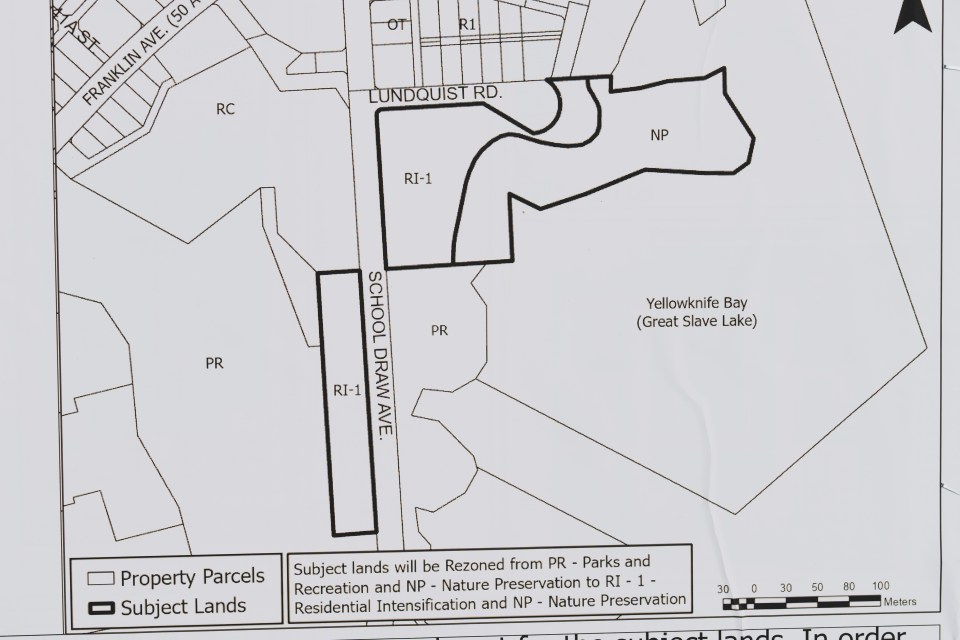
The areas in question are directly across the street from Lundquist Road, as well as across the street along the west side of School Draw Avenue.
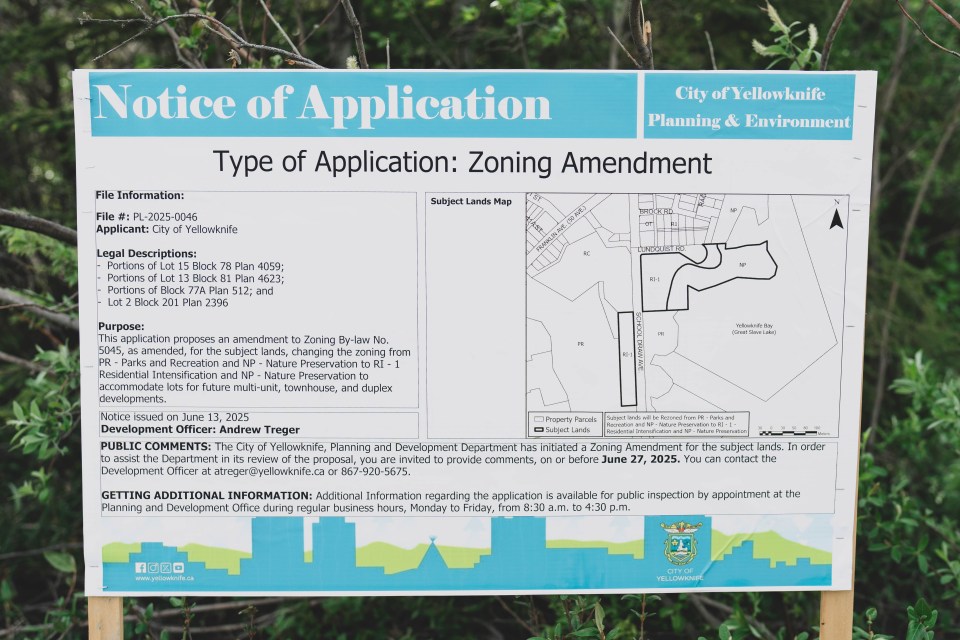
They are currently zoned as parks and recreation and nature preservation land.
The proposed change will see a strip of the parks and recreation zone west of School Draw changed to RI-1, which stands for light residential intensification.
Advertisement.
Advertisement.
Across the street from Lundquist, an open space zoned as parks and recreation currently acting as a pop-up skate park would also become RI-1.
The RI-1 zoning is different from RI, the standard residential intensification zoning code, in that it supports residential intensification on a reduced scale where land and properties are limited by factors like their topography.
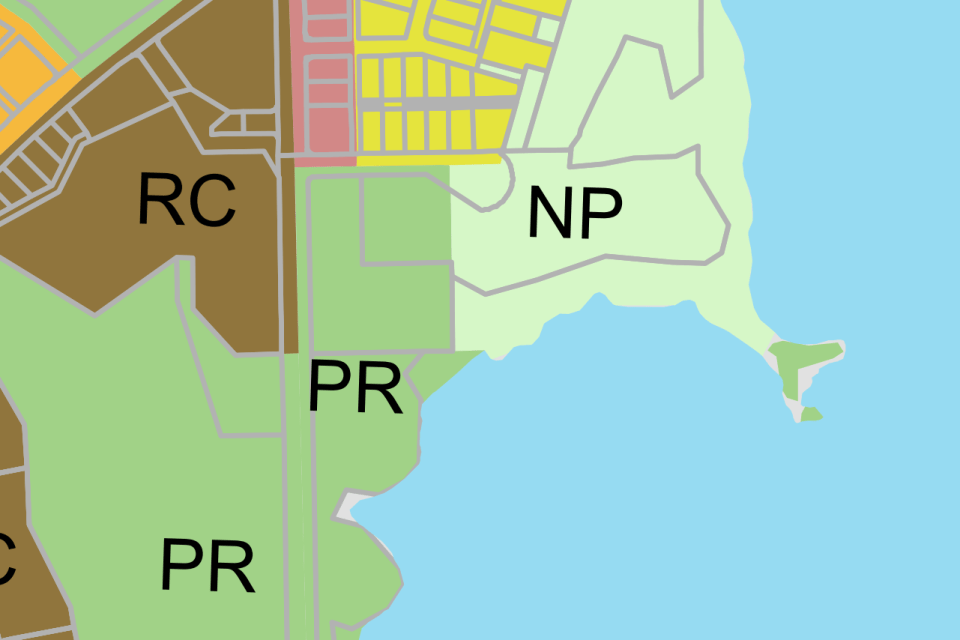
Both new zones were introduced when Bylaw 5095 passed in late October 2024.
The zones primarily permit multi-unit dwellings and townhouses – with no single detached dwellings.
Advertisement.
Advertisement.
Just behind the skate park, there’s a section of brush bordering Great Slave Lake that is currently zoned as a nature preservation area. This area would remain mostly intact under the city’s plan, gaining some land in its southwest corner from what was parks and recreation space, while losing land in its northwest corner to make room for residential intensification.
In September 2024, city staff said the new types of zoning were intended to support “missing middle housing,” a housing size between large apartment complexes and single-family homes.
Vivian Peng, a city planner, said at the time the zones were intended for land or properties where infill is ideal. Peng said the city did not intend to re-zone entire neighbourhoods.
Willow Flats, a nature area?
The city has historically viewed Willow Flats as an area to be protected and preserved.
In 2005, the city published a parks, trails and open space study commissioned from Dillon Consulting that included a list of key areas “that require significant protection.”
While Willow Flats was not on the list, it did get a special mention that read: “In addition to these main areas, the Willow Flats area is addressed in the ecologically sensitive areas map as an ecological preserve.”
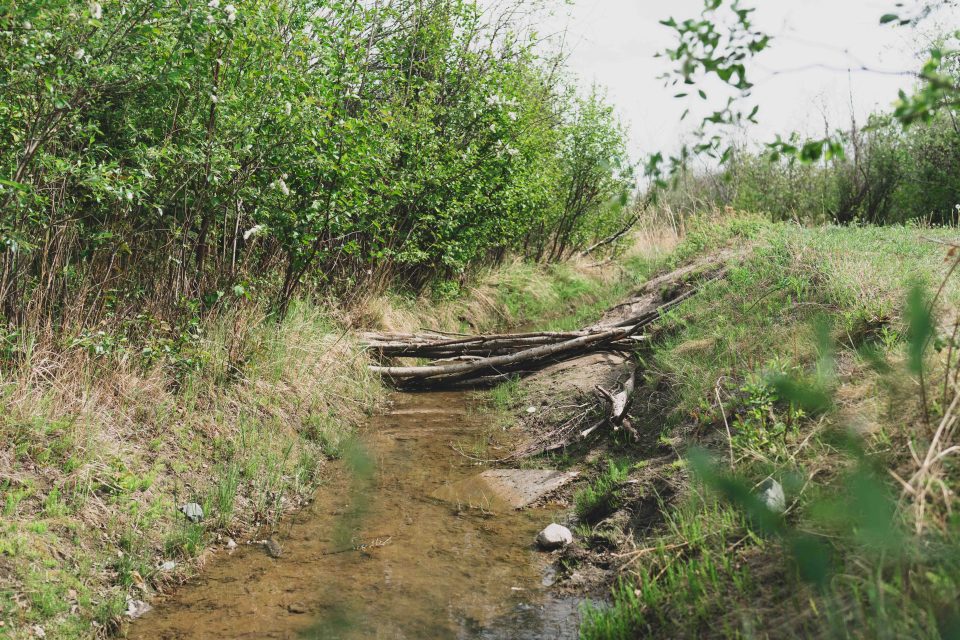

The map portrays the Willow Flats area as a home to wetlands, songbirds, waterfowl, small mammals and fish.
A 2010 report, also by Dillon Consulting, listed both Willow Flats and its shoreline as “natural area sites” that “satisfy the conditions for a high level of protection.”
Advertisement.
Advertisement.
“Natural areas are retained and protected in cities across Canada for their contribution to sense of place, environmental health, stormwater management, and beauty. A strong case has already been made for retaining natural areas in Yellowknife’s urban environment in previous studies undertaken by the City,” the 2010 report stated.
In the city’s 2020 community plan – which is in the middle of an overhaul – staff reiterated the findings of the 2010 report, stating: “There are several open spaces or natural areas in Old Town that have been identified for a high level of protection … All areas are intended to remain as natural areas.”
On Monday, Yellowknife Mayor Ben Hendriksen told Cabin Radio that view began to change in 2023 as city council started to implement the community plan, which had already identified the long strip of land west of School Draw as an area for potential infill.
At the same time, additional parcels of land were brought to council for consideration. Those included, for the first time, the area across from Lundquist Road.
“Council at that time debated: do we want city admin to start working towards bringing these pieces of land to market? Especially around this piece of land in particular, there was some debate at that time,” said Hendriksen.
“Ultimately, the majority of council decided to ask admin to go and do that work.”
Hendriksen noted some councillors at the time shared concerns about green space and wetland conservation.
‘If we don’t hear it, we can’t consider it’
Now, the process has finally reached the public engagement stage.
Advertisement.
Advertisement.
Hendriksen encouraged people to provide feedback on the proposed rezoning, either by emailing the contact listed on the posters, calling 867-920-5675, or emailing all of council.
After the feedback period closes on June 27, city administrators will put together a report based on what was heard. That will be shared with council later this summer.
“Then council will decide, do we still want to proceed? Do we not want to proceed, based off of all of that information that we have in front of us?” Hendriksen said.
But for now, he said, “it’s a process, a conversation.”
“I know sometimes people can feel like, what’s the point? There’s always a point in my mind. If we don’t hear it, we can’t consider it. So if you want us to know your views on something, then people do need to feed into that process.”
Yellowknife resident Kim Harrower has already sent feedback to council.
Harrower feels strongly the areas in question should remain green spaces. She spoke to Cabin Radio about families she has watched enjoying the area.
“It just seems such a good, natural space for everyone, no matter who you are and what your abilities are,” she said, describing the space as accessible for children, people with mobility issues and, of course, birders.
Advertisement.
Advertisement.
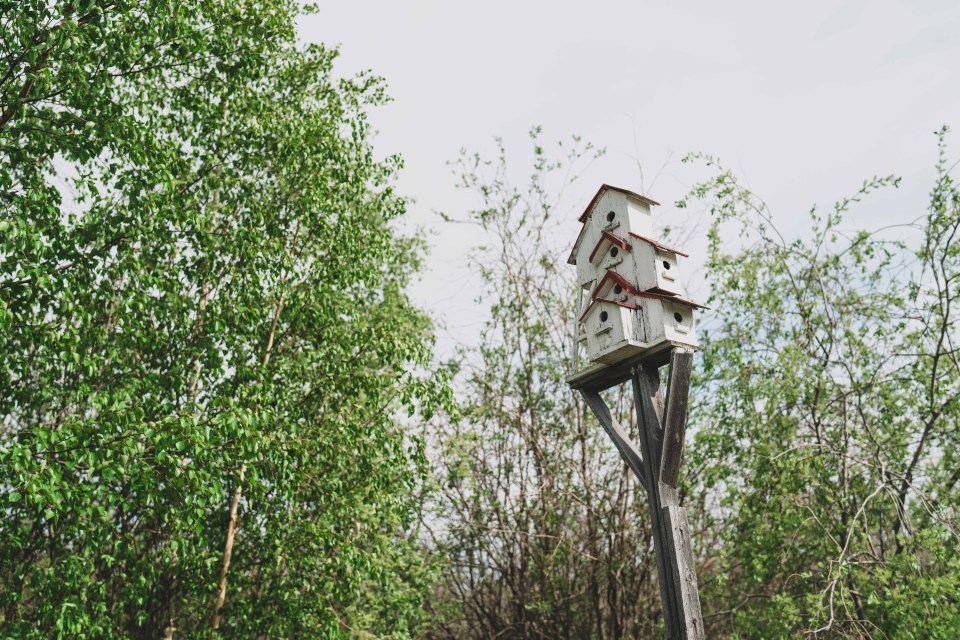
“Only a couple of weeks ago, there were half a dozen sandhill cranes down there. Raptors and eagles sit on the rocks in the water and it’s marshland, for goodness sake. That’s why there’s so much wildlife,” Harrower said.
“Why would you want to build on marshland anyway, when there’s so many other places in Yellowknife that actually need repurposing and houses built on them? Why take away a thing of beauty that so many people enjoy?”
Harrower pointed to other areas of land that host derelict buildings, preferring city council encourage development on those lots instead.
“People shouldn’t be able to just sit on things,” she said. “Even if the city doesn’t own things, there should be some discussion going on and changing things so that after so many years they need to buy it back.”
Marcus Jackson, another resident, sees Bylaw 5095 as an attempt to “reduce unnecessary encroachment on green spaces” by filling in under-utilized and vacant lots. He doesn’t think the Willow Flats lots are the same thing.
“Numerous parcels listed in the city’s land inventory remain undeveloped despite being zoned for residential use. These are precisely the areas that the ‘intensification first’ policy was created to prioritize,” he wrote.
“I have concerns that the continued development and focus on removing green spaces will significantly impact the city’s commitments to the environment, the accessibility to natural green spaces for residents, and the ability of the public to have access to natural spaces within the city limits.
“I also have grave concerns for the continued protection of habitat for native and species at risk, the function and benefits of wetland areas, and for the city’s developing disregard for protection of nature in general.”
City Hall is also planning infill development at the Gitzel Street and Matonabee Street intersection by rezoning it from parks and recreation to RI-1.
Jackson said he is worried that doing so sets a precedent for other parks and recreation or nature preservation areas to be readily rezoned.
