


“I want people to understand that no one is living in encampments because it’s a preferable way to live.”
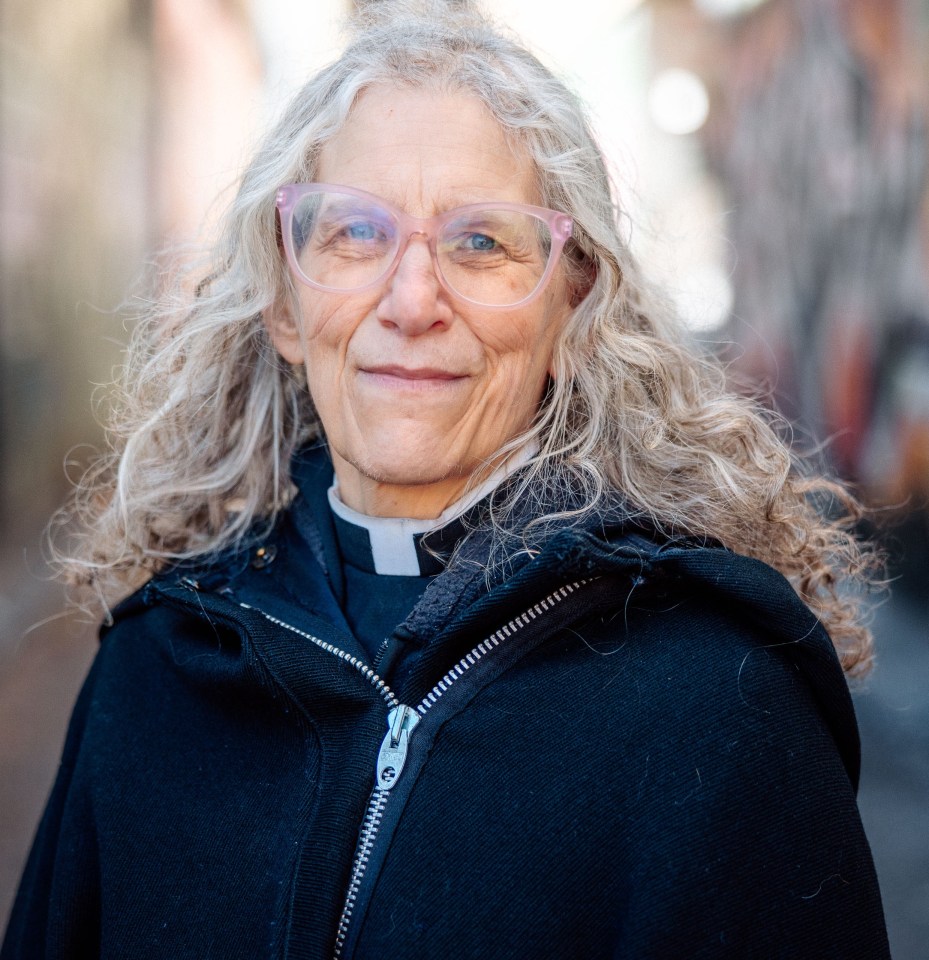
Maggie Helwig is a writer, activist and the rector of St Stephen-in-the-Fields, an Anglican church in Toronto whose churchyard became home to an encampment in the spring of 2022.
Over nearly four years, Helwig formed friendships with many of the people living in the encampment and fought to keep it from being shut down.
Earlier this year, she published a book called Encampment: Resistance, Grace and an Unhoused Community, an excerpt from which was printed in The Walrus.
The book details the story of the church encampment and introduces readers to three of its residents while examining the broader homelessness crisis.
Advertisement.
Advertisement.
“I think the main message of the book is that we are not different from each other,” Helwig recently told Cabin Radio.
“People who are living in encampments are not a different species, they’re not a different kind of human being. They are the same struggling, creative, complicated human beings as everyone else, and they are trying to survive in very, very difficult situations. And in those situations, they are finding community.”
Less than 24 hours after Helwig won the 2025 Toronto Book Award for Encampment last month, the City of Toronto cleared the encampment outside her church, which it deemed to be a fire hazard.
She said that was “very disruptive” for people who were living in the encampment and has negatively affected their mental health.
Advertisement.
Advertisement.
‘Encampments make visible what has been hidden’
While Toronto is more than 3,000 km from Yellowknife, Helwig’s book contains lessons about encampments and homelessness that are applicable to urban centres facing housing crises across Canada
Though some people experiencing homeless in Yellowknife have long lived in tents, encampments in the city have become more visible in recent years.
“In every case, encampments make visible what has been hidden,” Helwig wrote in her book.
As in other Canadian cities, there are housed people in Yellowknife who support those living in encampments as well as housed residents, businesses and politicians who oppose encampments as an approach.
Indigenous people are overrepresented among those experiencing homelessness in Toronto and Yellowknife, while the number of unhoused people has risen in both cities.
And like the former encampment outside Helwig’s church, there are concerns about fire hazards at an encampment in Yellowknife.
‘We have to try to learn to live together’
Helwig said systems are failing unhoused people and there can be misunderstandings and misinformation about encampments, mental health and addiction. She said speaking to people living in encampments is important to understand them before making decisions that affect them.
“You can’t understand other people without building relationships with them,” she said. “You can’t know … how the systems are failing them, unless you talk to them about their first-hand experience with the system.”
Advertisement.
Advertisement.
While many cities across Canada have been clearing out homeless encampments, Helwig argues that displaces people without addressing the underlying issue.
She said shelters are not long-term solutions and people can face barriers or feel unsafe accessing shelters.
“I would like to see our societies in general understand that until we are prepared to provide for decent housing and decent living conditions for everybody in our society, there will be encampments,” she said, adding that people cannot address mental health or addictions issues until they are housed.
In the interim, Helwig advocates for a harm reduction approach that considers how to make life better for people living in tents, reduce fire risks and manage the relationship between encampments and their neighbours.
“Nobody ever seems to have thought that this was a way that we could go forward but, in the short term, I think it’s the only way we can go forward,” she said. “We have to try to learn to live together.”
This interview was recorded on October 30, 2025. The transcript has been lightly edited for clarity.
Emily Blake: What prompted you to write the book about the encampment?
Maggie Helwig: Well, it wasn’t my idea to write it. It was suggested to me by an editor at University of Toronto Press, actually. Even though I ultimately took it to another publisher.
Advertisement.
Advertisement.
I was hesitant at first, because there’s a great risk in an outsider with some privilege writing about people who have much less privilege and who are in a much more difficult situation. There’s dangers of sensationalism or sentimentalism or exploitation. So I was hesitant.
I talked to some of the people in the encampment who seemed to think that I should go ahead. And I thought about it, and I thought I’m someone who has access to channels of communication, but has also been trusted with knowledge of people’s lives and information about how the systems are failing them. Which very few housed people have. So it seemed like that put me in maybe a unique position that I had a responsibility to and that by writing the book, maybe I could give voice to things which people need to hear and are not hearing.
What would you say are the main messages from the book that you want people to take away from it?
I think the main message of the book is that we are not different from each other.
People who are living in encampments are not a different species, they’re not a different kind of human being. They are the same struggling, creative, complicated human beings as everyone else. And they are trying to survive in very, very difficult situations. And in those situations, they are finding community. They are building community, they are supporting each other, and they are creating something which they shouldn’t have to create.
They’re in a situation they shouldn’t have to live in, but they are making out of it something which is actually, in many ways, quite inspiring and meaningful.
The book specifically shares the stories of a few long-term encampment residents. Why was it important for you to share their stories?
I think so people could understand that these are real people. That they’re people with whom I have real and meaningful relationships. That they’re people who have a lot of gifts, people who are very creative, people who are clever in survival skills in ways that astonish me, people who have artistic ambition, people who look after each other. You know, not weird, dangerous, frightening people, but my friends.
Advertisement.
Advertisement.
The book talks about society’s callousness toward people that are experiencing homelessness or living in encampments. In your experience, where do you think that callousness comes from?
I think it comes from fear. Not all my colleagues agree with me. Some of my colleagues think people are just selfish.
I think people are frightened. I think to allow the knowledge that people living on the street or living in tents are fundamentally the same as you, is to acknowledge that you could be there or your kid could be there. Everyone in an encampment is somebody’s kid.
People don’t want to face that. They don’t want to face that we are all weak and vulnerable. We all struggle sometimes with our mental health. We all behave in ways that are less than ideal. Some of us have enough privilege that we can have a bad day and get past it. If you don’t have that privilege, a bad day comes to define your life. And I think that’s a very frightening thing to confront, to confront that we are all weak and mortal and fragile.
I think the more privilege you have, the more you try to block that awareness out of your life, and the more frightening it becomes. And so anyone who reminds you of that becomes a kind of existential threat, and all you can think of is you need to make them go away.
At the start of the book, you write about some neighbors not wanting to talk to the people in the encampment. What would you say is the importance of people actually getting to know people that are living in encampments before passing judgment or making decisions about encampments?
I think you can’t understand other people without talking to them. You can’t understand other people without building relationships with them. You can’t know, as I said earlier, how the systems are failing them, unless you talk to them about their first-hand experience with the system.
But also it’s the only way to get past fear. If you start to talk to people, and you start to realize that they are just people and you can talk to them, they become not this strange, frightening presence, but people you can name.
Advertisement.
Advertisement.
I’ve sometimes asked the people who were hostile to the encampment, or who blame the encampment for all the crime in the neighbourhood or whatever: can you tell me the name of a single person in the encampment? If you think they’re doing all the crime in the neighbourhood, what’s their name? And there are absolutely people in our neighbourhood who know the names of lots of people in the encampment, who know them and talk to them. But the people who are most hostile, they don’t even know who people are.
Why is your approach, and the approach of your congregation who was supportive of the encampment, different from other people’s perspectives?
Well I don’t think it’s different from everyone’s perspective. Many people have been very supportive, especially in our neighbourhood. We found a lot of the neighbours were very supportive. Some were hostile, but certainly not all.
I do think that pretty-much everybody in my congregation has experienced some kind of marginalization. Whether it’s for their race or whether it’s for their sexual or gender orientation, or whether it’s for reasons to do with mental health or the use of alcohol or drugs. Most people in my congregation have had struggles and have known what it is to be someone who is on the outside of good society. So I think there is an automatic feeling that the people in the encampment are not different from us, that we’re all one community and we’re all trying to support each other.
Why was it important for you to provide this sanctuary for people and to advocate for the encampment to stay?
Well, because I’m a priest and because the role of the church is to be there for people who need us. Because the church has always been sanctuary. Because if someone comes to a church and says “I need sanctuary” or “I need help,” you can’t send them away. That’s betraying your very identity.
The book talks about how people who are housed and comfortable, they can have a lot of misunderstandings about encampments. What would you want them to know?
I want people to understand that no one is living in encampments because it’s a preferable way to live.
Advertisement.
Advertisement.
There’s not just misunderstandings, there is misinformation. You will frequently find agencies and governments saying that people have been offered housing and turned it down. In my experience, this is never true. People may turn down temporary shelter space because it’s not a long-term solution, because it’s pretty bad conditions. People may not want to go into a temporary shelter, but people are not being offered housing. There is virtually no housing. A tiny, tiny handful of people from the encampment have been offered housing over the years, and they have taken it. They have gone into housing when it’s been available to them.
I’ve heard people say, “Oh, they could be housed right now, but they’d rather do drugs.” I mean, people in houses do drugs. People need to be housed in order to be able to address issues of problematic substance use, issues of mental health. If you’re on the street, it’s almost impossible to deal with those issues. You have to get into housing first, and then you can start to address all the other things that they need work in your life.
The other thing is there’s an idea that people in encampments are violent or dangerous. I’ve never felt unsafe with the people living in the encampment. That’s partly because they know me and they have a lot of respect for me, but, you know, I’ve gotten that just by being ordinary and friendly. They’re not violent people. They’re people who are just trying to live their lives and trying to survive.
The book also talks about facing challenges with the municipality. What would you want to say – whether it’s Toronto or another city or another territory or province – to politicians and officials that are looking to make laws and policies that deal with encampments?
I’d say the only way to deal with encampments permanently and decently is to get people into housing.
If municipalities are pursuing a policy of forcibly clearing encampments without providing housing, all they are really doing is chasing people from park to park. That’s what Toronto has been doing. They know if they clear people out of one park, they’ll go to another park. But it means that the set of neighbours who’s been complaining will stop. And then they’ll be replaced with a different set of neighbours, but it will take some time. It’s a ridiculous game of human whack-a-mole.
I’m aware that there are some jurisdictions which are trying to move towards involuntary treatment. I think that’s an incredibly dangerous direction to go. On an absolutely pragmatic level, it’s an extremely expensive direction to go. It is like housing people, but in the most expensive imaginable way. It costs much more to keep somebody in a hospital or a jail than it does to keep them in supported housing. But it also opens the floodgates to the criminalization and involuntary detainment of anybody who is living in any kind of way that a government happens not to approve of. And I think we’ve seen some of where that can go in the United States. I don’t think we want to be opening the door to that in Canada.
Involuntary treatment, by the way, has an extremely poor success rate. So if they’re saying that they’re going to drag people in and force them to be treated, it doesn’t work. Voluntary treatment can work. Different models have different success rates. Involuntary treatment generally fails.
Advertisement.
Advertisement.
How have you seen the housing crisis and the experience of homelessness change in Toronto or even across Canada over time?
Oh, it’s gotten massively, massively worse.
I mean year on year, since 1995 or earlier, the census of people who are unhoused is larger. Every year, the shelter system keeps expanding and still can’t meet the need. Every year, affordable and supportive housing flatline. We still have close to the same amount of affordable and supportive housing we had in 1995. Social assistance rates are comparative to the poverty line further and further and further behind. The whole situation has just spiralled.
I would say in Ontario, it was very easy to see this coming. The policies of the Mike Harris government in the 90s were exactly engineered, causing this sort-of slow-motion social collapse so that everything would fall apart, but it would happen slowly, and when it did happen, the municipalities would be blamed for it.
Ultimately, the city shut down the encampment saying it was a fire hazard. What impact did that have on people living there?
It’s been very disruptive for most of them.
A lot of them, they’re wandering around the streets now trying to find somewhere that they can put up a tent where they’ll still be near to the agencies from which they’re getting support, case workers with whom they’ve been working. They’re trying to stay near to all those supports. Right now, a lot of them are out in the rain trying to figure out where to go. I’m already seeing people’s mental health deteriorating.
A couple of people, I think, are still in shelter hotels. And that’s great because they’re out of the rain, but the Toronto shelter hotels evict people really easily. So I expect that they will be back on the street soon, because they do something like miss a single bed check or bring in some food that they forgot they weren’t allowed to bring in. The bar for eviction is very low.
Advertisement.
Advertisement.
It sounds like you’re still able to stay connected with some of the community members.
We’re making a huge effort to stay connected with them. They’re people who became our friends and really part of our lives and our community. So we don’t want to lose contact with them. We’re working very hard to stay connected with them.
What do you think other places across Canada could learn from your experience or the experience of this community?
I would really like to see Toronto, I would like to see our societies in general, understand that until we are prepared to provide for decent housing and decent living conditions for everybody in our society, there will be encampments.
What has to happen in the interim is more of a kind-of harm reduction approach to encampments. More of an approach that says, “How do we make life better for people who are living in tents? How do we reduce fire risk? How do we manage relationships between the people living in the tents and the other people in the neighbourhood? How do we all learn to live together as fellow human beings?”
Nobody ever seems to have thought that this was a way that we could go forward. But in the short term, I think it’s the only way we can go forward. We have to try to learn to live together.
