


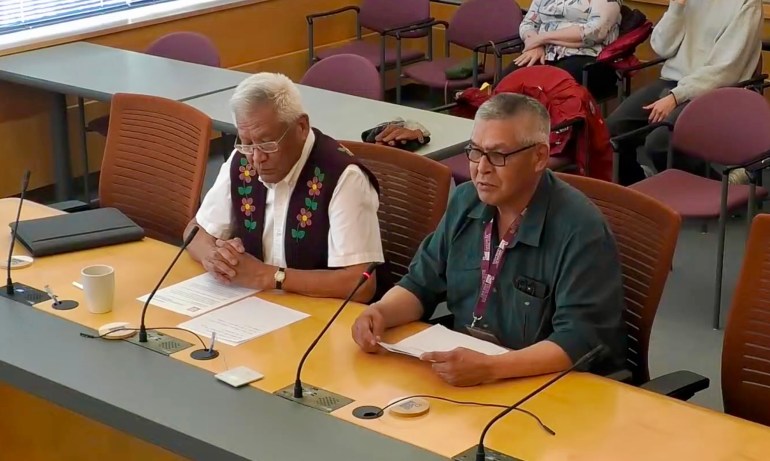
Tsiigehtchic Elder Lawrence Norbert wants NWT MLAs to pass legislation that he says would protect residents’ ability to express themselves and promote debate on matters of public interest.
At the Legislative Assembly on Tuesday evening, Norbert told a committee of MLAs that many people – himself included – learned to keep quiet and “not to rock the boat” in residential school, or else they would be punished.
“The legacy of silence still impacts many of our communities today,” he said, alleging some leaders have used that to silence critics and suppress debate.
“We are finally finding our voices. We cannot allow lawsuits to take them away.”
At the request of Norbert, Mackenzie Delta MLA George Nerysoo introduced Bill 46, a private member’s bill, in the Legislative Assembly in March. The bill proposes protections for people being sued in the NWT for expressing themselves on matters of public interest.
Advertisement.
Advertisement.
“The purpose is to protect innocent people from being bullied or gagged by perhaps larger or more well-resourced parties, just for speaking their mind,” Nerysoo said.
“However, the bill would not protect deliberately false, hateful or malicious speech.”
What is Anti-SLAPP?
The legislation proposed in Nerysoo’s bill is known as an anti-SLAPP law.
SLAPP stands for strategic lawsuits against public participation, described as threats of legal action intended to intimidate and silence critics by burdening them with costs and time-consuming litigation.
Advertisement.
Advertisement.
Anti-SLAPP laws allow people being sued for speaking on matters of public interest to apply to the court for early dismissal of a lawsuit. In some cases, they may also be able to recoup money they have spent fighting the lawsuit and potentially win damages.
Such laws have been enacted in Ontario, British Columbia, Quebec and, most recently, Manitoba.
Nerysoo’s bill is modelled after Ontario’s Protection of Public Participation Act, which the Centre for Free Expression at Toronto Metropolitan University ranked as the strongest anti-SLAPP law in the world in a 2023 report, alongside similar legislation in BC.
What is in Bill 46?
Under the legislation proposed in Nerysoo’s bill, a judge may dismiss a lawsuit early if a defendant can demonstrate it’s related to an expression on matter of a public interest and the person that filed the lawsuit is unable to prove that:
- the lawsuit has substantial merit;
- the defendant has no valid defence; and
- the harm caused by the expression is serious enough that the public interest in continuing the lawsuit outweighs protecting the expression.
If a lawsuit is dismissed as a SLAPP, Bill 46 proposes allowing a defendant to recoup some of their court costs unless a judge decides otherwise.
The person who filed the lawsuit could face damages under the bill, if the lawsuit is found to have been brought in bad faith.
Justice minister Jay Macdonald said his department is supportive of the proposed legislation.
Bill 46 passed second reading in March 2026 and is now being reviewed by a committee of MLAs.
Advertisement.
Advertisement.
If approved, the legislation would only apply to lawsuits filed after it becomes law.
Norbert facing defamation lawsuit
Norbert told committee members this week he is “embroiled in litigation right now” but could not discuss specifics.
Discussing his views on the need for anti-SLAPP, he said generally “there is a chilling effect on the soul when the RCMP knock on your door to serve you” a lawsuit and many people do not have the funds to hire a lawyer to defend themselves.
Court records indicate the Gwich’in Tribal Council and former grand chief Ken Kyikavichik filed a defamation lawsuit against Norbert in NWT Supreme Court in July 2024.
The GTC and Kyikavichik sought damages in that suit, alleging Norbert made defamatory statements that disparage and reflect negatively on their reputation and character. The lawsuit claims the defamatory statements were made in emails Norbert wrote to the GTC as well as letters to the editor he penned and an article he is quoted in, published by NNSL.
The publications include comments on Kyikavichik’s move from Inuvik to Edmonton, a decision to eliminate the GTC’s deputy chief position, and Norbert being barred from participating in a self-government negotiation main table session, among other topics.
Norbert has not filed a statement of defence in response to the lawsuit’s claims, which have yet to be proven in court.
MLAs asked for anti-SLAPP in 2019
Norbert is not the only one who has advocated for the NWT to have anti-SLAPP legislation.
Advertisement.
Advertisement.
That was one of the recommendations that came out of a review of the territory’s Environmental Rights Act before it became law.
The committee of MLAs reviewing the then-proposed legislation said residents had expressed a desire for whistleblower protection to be expanded beyond employees, to prevent retaliation against all citizens that request investigations into environmental harm.
The committee concluded the issue was wider than the Environmental Rights Act and the NWT should develop a standalone anti-SLAPP law.
MLAs passed a motion in August 2019 calling on the territorial government to begin working on such legislation for introduction in the 19th Legislative Assembly.
The issue was raised again in the Legislative Assembly in March 2020 by then-Frame Lake MLA Kevin O’Reilly, questioning when anti-SLAPP legislation would be introduced. Shane Thompson, then the environment minister, said it was not his department’s responsibility but he had contacted the justice minister on the issue.
On Tuesday, several MLAs expressed support for Nerysoo’s bill.
“I think this is a good private member’s bill,” said Inuvik Boot Lake MLA Denny Rodgers, calling it something “we will be able to move forward.”
Kieron Testart, the MLA for Range Lake, said concerns about freedom of expression and fear of reprisal are “deeply felt in all communities, large and small” in the NWT.
“Any tools we can bring forward to protect the … Charter rights of citizens to speak their piece on issues that are important to them is a huge benefit and I support it fully,” he said.
