

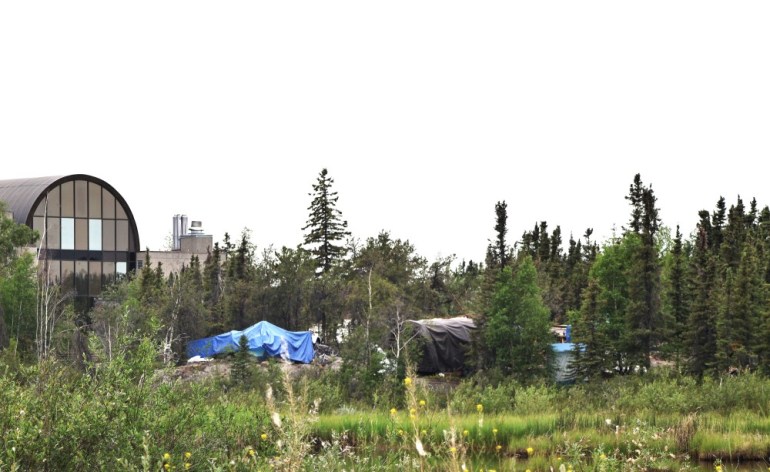
The territorial government has published an encampment response framework that dictates how such settlements in Yellowknife are to be managed.
However, those who work with people experiencing homelessness say the framework doesn’t represent meaningful change or do enough to support residents.
The framework, published by the NWT government on Wednesday, sets out how encampments in Yellowknife will be managed by Housing NWT in partnership with other territorial departments, the City of Yellowknife and RCMP.
In a news release published last week, the GNWT said the framework will ensure its response to settlements remains “clear, coordinated, and consistent.”
The framework outlines each step of the response, from the “detection” of an encampment, to mitigating possible risks associated with it (including fire and environmental factors), to the considerations for closing an encampment.
Advertisement.
Advertisement.
The GNWT says residents will be treated with dignity and respect and its front-line workers will offer shelter, housing options and health supports to encampment residents.
Tony Brushett, executive director of Yellowknife’s Salvation Army, said that to his understanding, the framework largely represents work already being carried out.
“Connecting the residents to services when requested through voluntary and respectful engagement – we’ve always done that,” said Brushett.
He said encampment residents sometimes use Salvation Army services such as the food bank, showers and laundry machines.
Advertisement.
Advertisement.
Over the past several months, Brushett said the 39-bed shelter has only reached capacity on three occasions, a change from what the shelter had experienced over the past few years. Only about 30 spots have been consistently used in recent months.
Lawyer Peter Adourian, who has represented encampment residents, says there are many reasons people might not seek out a shelter bed, including inadequacies in the system.
“My clients have expressed to me that they have experienced racism when trying to access the shelters. They have expressed to me that they can’t keep their belongings with them if they access shelters, because there isn’t enough storage space,” said Adourian.
He said pets and partners may also play a role, as there are currently no shelters in the city that allow for both men and women to stay overnight.
“There are people in the encampment who are in opposite-sex relationships and they want to stay together at night, just like any family wants to stay together at night,” said Adourian.
Brushett said some people, due to mental health issues or addictions, may not be able to abide by the rules of a shelter.
He added some of the disparity between the number of shelter beds available and the number of people using them could come down to the capacity of outreach staff.
“I don’t think the outreach folks have the capacity or time to spend a lot of time with each individual to try and convince them: ‘Can we drive you to the shelter tonight?’ They make the offer every night, but very seldom do we see people getting dropped off by Line Drive to the shelter at 11-12 o’clock at night any more,” said Brushett.
Advertisement.
Advertisement.
Additionally, Brushett said the new 24-bed transitional housing facility that opened late last year has been full for several months, and has been helping to move people out of the shelter system.
Encampment closures
The newly published framework says a group of Housing NWT employees called the Coordinated Encampment Response Team, or Cert, will coordinate actions and departmental responsibilities when an encampment presents a manageable risk, such as fire hazards, sanitation issues or environmental concerns.
Should those issues not be mitigated, the framework dictates the land owner or authority would decide what should happen next.
It also sets out a pathway for the closure of an encampment, should a court order be obtained.
Adourian said that while this area of law is still evolving, evictions are not an immediate concern for his clients.
“The GNWT and the city have never brought the matter into court for an order, because they know that they won’t be able to get one,” said Adourian.
“In order to convince a judge to remove an encampment, they have to prove – and this is a standard across Canada right now – that there are enough emergency beds available to account for all the homeless people in that region, and we’re not even close to that number.”
He pointed to the last point-in-time homeless count conducted in Yellowknife in October 2024, which found that 327 people were experiencing homeless. Comparatively, the city currently has fewer than 100 emergency beds available.
Advertisement.
Advertisement.
Supports for managing encampments
The press release that accompanied the framework discusses coordinated cleanup work to remove waste and possible health and safety risks, while taking “reasonable steps to avoid the removal of personal belongings.”
At a city council meeting last month, the territorial government faced pressure from Yellowknife councillors to create a plan to deal with excess garbage on commissioner’s land, which they said is sometimes associated with encampments.
Adourian said he’s long advocated for an encampment located near the Prince of Wales Northern Heritage Centre to be provided with a dumpster to help manage waste from the site.
This, he said, would allow for residents to deal with their own garbage instead of relying on governments to do so.
Additionally, he said he has been privately fundraising to cover the cost of things like garbage bags and a portable toilet installed on the site, which he said costs about $600 per month for cleaning and pump-outs.
“The [territorial] government has refused to take over payments for that toilet, so instead it’s the rest of Yellowknife that’s on the hook to pay for this,” said Adourian.
“This is just another procedural document that gets us no closer to good results,” he added, referring to the framework.
