

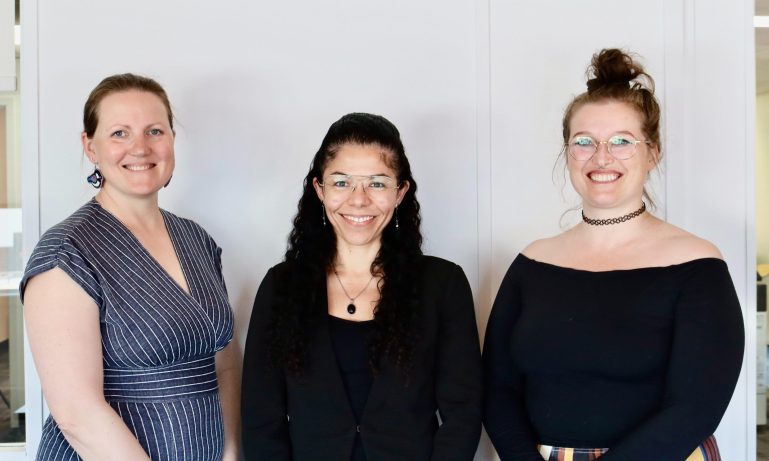
Representatives of education and research institutions across northern Canada gathered in Yellowknife this week to collaborate on addressing shared challenges and priorities.
“One message that became very clear to all of us is that we are so much stronger together,” Danielle Freitas, dean of research at University College of the North, told Cabin Radio.
University of the Arctic, or UArctic, is an international cooperative network of more than 200 organizations focused on education, research and knowledge exchange across the circumpolar North.
Within UArctic, an informal Canadian northern members’ network includes University College of the North in Manitoba, Nunavut Arctic College, Yukon University, and Memorial University of Newfoundland alongside the NWT’s Aurora College, Collège Nordique and Dechinta Centre for Research and Learning.
According to a press release, the northern network formed amid a renewed emphasis on strengthening Canadian participation in UArctic and a desire among members to ensure education initiatives are developed “in, for and by the North.”
Advertisement.
Advertisement.
“One of the things we’re really centring on is the need to gather our voices together to enhance the message that things in the North are different,” explained Davon Callander, director of research and innovation at Yukon University.
“The programs and services that are available – and that are born out of the ideas in the south – often don’t fit the needs of academic and research among northerners.”
Callander said a “unified voice” on issues like policies and funding eligibility could help change how northern research and post-secondary education is supported. That’s important, he added given the current “geopolitical atmosphere” and focus on Canada’s North and the Arctic.
Gemma Richardson, manager of research and scholarly activity at Yukon University, said it is “essential” for the federal government to have northern voices at the table when planning initiatives, rather than trying to figure out how the North fits in after the fact.
Advertisement.
Advertisement.
“We often feel that northern voices are missing from the discussion, even when the conversation’s about the North, so this is a key part of what we’re trying to do, is raise the voices of the North and the communities that we’re trying to serve here,” she said.

During a previous meeting in St John’s, Newfoundland and Labrador, members of the northern network agreed on eight themes for collaboration:
- northern food sovereignty and security;
- land-based learning;
- Indigenous and northern research governance and ethics;
- Arctic security;
- northern languages preservation and revitalization;
- collaboration and communication tools;
- knowledge exchange; and
- capacity building.
During this week’s meeting in Yellowknife, representatives discussed those shared priorities as well as challenges, and worked to formalize a collaboration framework.
Some of the challenges many northern institutions face, Callander said, include precarious research funding and a division between academic instructing faculty and research faculty. Freitas added that building capacity with limited resources is difficult.
“We are different in so many ways but we are also very similar,” Freitas said.
Callander said discussions this week also included the possibility of organizing a UArctic northern members’ conference.
“There are so many different opportunities,” she said, “and we’ve been brainstorming over the past couple of days of what we might do together.”
