



The MLA representing residents near a Yellowknife tent encampment says lessons the territorial government can learn for the future include the need for a better dialogue with people.
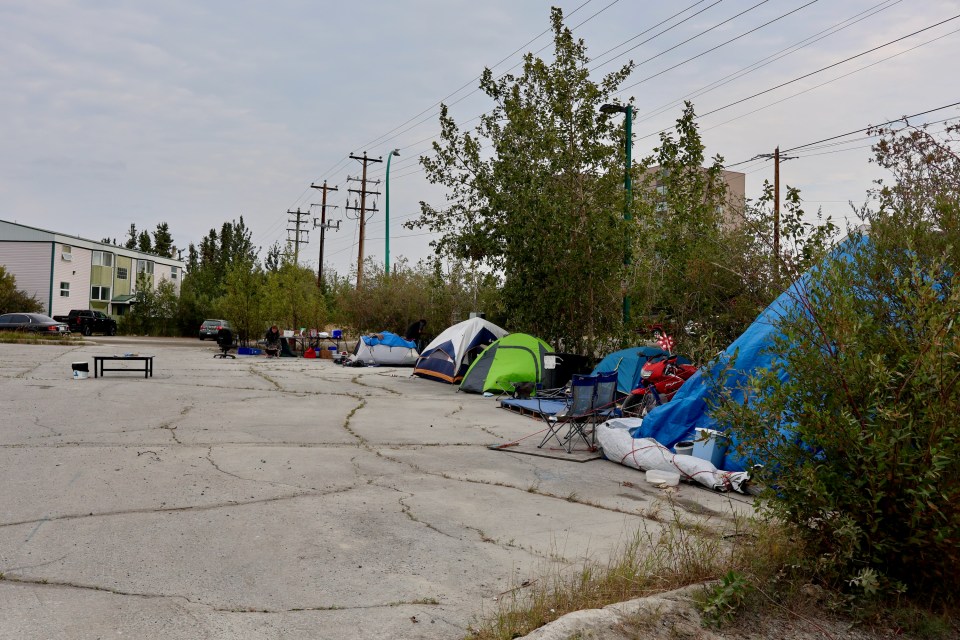
An encampment that appeared opposite a high school in early August has since moved to a vacant lot several blocks away. The encampment is inside Great Slave MLA Kate Reid’s district.
The territorial government has installed a portable toilet on the lot and says it will erect “temporary fencing” for the next few weeks. The GNWT says the encampment has to leave the lot by mid-September so renovation work can commence on the adjacent Aspen Apartments.
Residents living in the area have complained about drug use, defecation, harassment and other disturbances that they associate with the encampment.
“The neighbours have come to a breaking point,” one resident told Cabin Radio on Thursday, requesting anonymity to discuss a sensitive topic. They said at least one firework had been let off at the encampment the previous night.
Advertisement.
Advertisement.
“There have been a lot of very visible drug-related issues. It is ballooning. There’s a video from one of the neighbours of a grown man defecating near the Montessori daycare,” the resident continued.
“We understand they have come into hard times, there are addiction issues and there is generational trauma. We have been very compassionate and quiet for the past week and some. It’s a situation where it’s like, ‘OK, just be patient and it’s going to go away.’ Well, it’s more than that.”
Interviewed on Friday, Reid said the territorial government’s response to the encampment had, in her view, been “perhaps a little bit weighted toward the direct needs of those folks [at the encampment] and maybe not so much the direct needs of the neighbourhood.”
“That’s definitely a frustration I’m hearing,” she said.
Advertisement.
Advertisement.
“There has been an exceptional amount of compassion for the people who are in this situation. Everybody understands it’s temporary, but they just want to make sure health and safety is taken care of for both the folks who are in the encampment and for the residents of the neighbourhood.
“Fundamentally, this is about people who are unhoused and need to have better supports. No one is disputing that, including the people who live in that neighbourhood full-time. But to be able to communicate appropriately to people who are anxious in urgent and developing situations is something I think we need to be doing a little bit better.”
‘It needs to be a safe experience’
Encampment members have said the actions of a minority of people are giving the group a bad reputation.
In interviews with Cabin Radio, people living at the encampment have acknowledged that the situation is not ideal, but they have said their present lot satisfies some basic criteria.
“I like it,” Colton Migwi told Cabin Radio earlier this month. “It’s on concrete, we have power. It’s also not too invisible from the public’s eye, so hopefully they can see us. We like to be heard. We like to be listened to.”
But the mid-September timeframe for renovation work on Aspen Apartments to begin – and, beyond that, the onset of winter – have resulted in the GNWT issuing a firm deadline by which the encampment must be gone.
What happens next “takes a number of us and it’s going to require a lot of coordination,” deputy premier Caroline Wawzonek told CBC North Trailbreaker host Jared Monkman on Friday.
“This is an encampment that will last only a short period of time but it needs to be a safe experience for all involved, and then needs to transition to a safe experience in an orderly way.”
Advertisement.
Advertisement.
Mayor Rebecca Alty, speaking on the same show, said she had urged colleagues and the GNWT to make quick decisions about how to proceed.
Recent meetings between levels of government were “an opportunity to reinforce that it can take time to get this stuff up and running, the permitting required, the legislation that guides all this,” Alty said.
The mayor said she had stressed that “we want to make sure ‘perfect’ isn’t the enemy of ‘good’ – we can’t sit around and bat around options forever. We’ve got to pick one and start actioning it.”
“I think that was heard loud and clear,” she told the CBC.
So far, the governments have not provided much detail about what the options look like for the encampment’s members.
“We have a number of options that we’re looking at with individual NGOs, where different groups who house different groups of people may be able to increase their capacity, depending on their funding and their space. But that’ll be a decision we will want to take with those individual NGOs. I don’t want to put any of them on the spot,” Wawzonek said.
“We’ve had some conversations with Indigenous governments and whether there’s some opportunities for them to have investments in this space as well, with a longer-term option from the GNWT backing them up.”
Reid told Cabin Radio she had been working with Premier RJ Simpson’s office, as homelessness is the premier’s responsibility under the territorial government’s current system of portfolios, and believed him to be looking into transitional housing as a longer-term solution.
Advertisement.
Advertisement.
In the shorter term, she said, “I think the best solution is what people are asking for – and each individual person is going to have a different answer for that.”
Reid said she had not spoken with anyone at the encampment. “I don’t want to put my political influence on what’s happening there. I am relying on EIA to do their work,” she said, referring to the Department of Executive and Indigenous Affairs, which Simpson leads as premier.
She also apologized to residents of the area for not meeting with them in person earlier.
“What I would have maybe done a little bit differently … folks are generally a lot more understanding and a lot more forgiving when you go and speak to them face to face. And that’s on me, too. I could have made myself available,” she said, referring to some residents’ frustration that they had little direct communication from the GNWT.
“I could have said ‘hey’ to EIA and demanded that we all go down and go door to door. That’s something I’ll wear,” said Reid, “and that’s something I have apologized for to residents.”
An urgent situation
The resident who spoke on Thursday said some people who live in the area were contemplating a meeting at the weekend about the issue.
The GNWT had begun handing out leaflets in the area, they said. Those leaflets state that the city will be responsible for garbage removal and the encampment residents “have agreed to be responsible for cleaning the portable toilets.”
“These resources should have been in on the Monday they were dropped off there,” the resident said.
Advertisement.
Advertisement.
In a statement, the territorial government said: “There are numerous factors that contribute to the unhoused population in Yellowknife, including those in the encampment on 51 Street.
“Each unhoused individual has their own story, and deals with their own combination of circumstances, and that is why homelessness is a complex issue that requires multiple partners collaborating to provide a comprehensive system of services and supports.
“The GNWT and its partners are working to identify these individuals, assess their needs, and help them navigate to the most appropriate available options. Where those supports may not be available, we are working to find solutions to capacity concerns and identify alternative arrangements.”
Reid said the territorial government is learning how to do a better job when handling future encampments or similar situations.
“The lesson that has really been learned – and I think RJ said to me quite bluntly – is there’s nothing like an urgent situation to really get the fires brewing on all levels of government to cooperate better,” she said, “and figure out what is needed for now and the long term.”
