



The past year brought “significantly more outages” than other recent years, the NWT Power Corporation told MLAs this week.
Greatest hits you might recall include the epic seven-hour outage of April 2025, a series of power cuts in August, two extended outages in December and a four-hour blackout in February.
Those are just the ones in Yellowknife, not counting major outages in other NWT communities.
At a briefing on Thursday, power corporation leaders acknowledged it had been a rough year.
“We did not do well in our reliability this last year,” said Cory Strang, the NWT Power Corporation’s president and chief executive officer.
Advertisement.
Advertisement.
“Our staff has done a tremendous job of all the work that they’ve done. But it is frustrating, it is tiresome, it is challenging. We hear it all the time. So we want to improve. We need to improve.”
The power corporation set out a broad overview of plans to improve how electricity works in the NWT – we’ll return to that in a second article – alongside a short case history of recent outages affecting its grid in the North Slave.
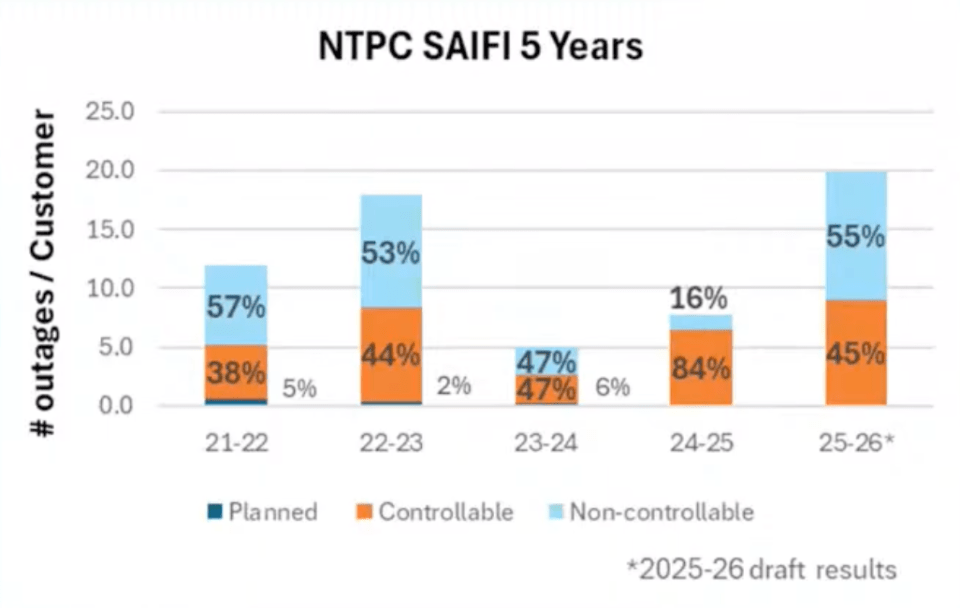
The above chart uses SAIFI – the System Average Interruption Frequency Index – which the power corporation described as an industry standard way of measuring the effect of outages on customers.
It measures how many times outages happen over 12 months, weighted by the number of customers impacted by each one. (The score isn’t as badly hit if an outage affects 10 people, compared to one that affects 10,000.)
Advertisement.
Advertisement.
“For 2025-26 we have had significantly more outages than, say, in the past two years and more than in the last four years,” NTPC chief operating officer Belinda Whitford told MLAs.
The SAIFI chart shows three categories of outage: planned, controllable and non-controllable.
Planned outages haven’t been a factor for a few years. Controllable outages are those “the utility has some influence over,” said Whitford, giving the example of equipment failure or human error.
Non-controllable outages are those that involve the likes of wildlife, weather or issues at Naka Power, the distributor that takes energy generated by NTPC and delivers it to homes in communities like Yellowknife.
Over the course of 2025-26, preliminary figures for the North Slave suggest each NTPC customer experienced an average of 20 outages.
“So if 2025-26 has felt like we’ve had more outages than normal, that is true,” said Whitford. “We have.”
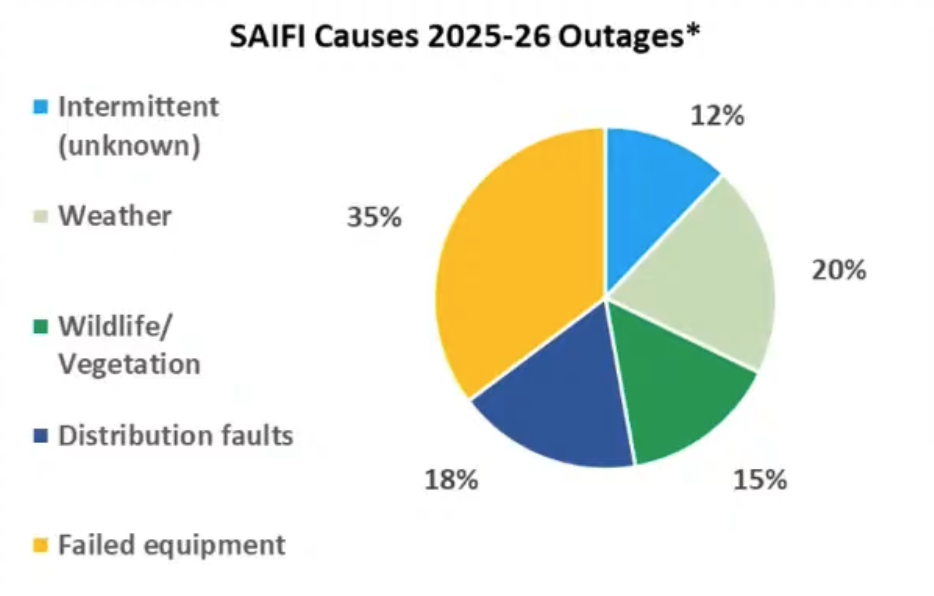
A separate pie chart produced during the power corporation’s presentation to MLAs set out a little more detail about what caused these outages.
Roughly a third of 2025-26 outages were down to failed equipment, NTPC said. Of those, half were down to one piece of equipment at the Snare Falls hydro unit. By December last year, the power corporation says that issue was under control and stopped having “a major impact” on outages. (The cause of that problem went undiagnosed for months. NTPC now says it was a turbine blade positioning issue.)
Advertisement.
Advertisement.
Eighteen percent of outages were distribution faults attributed by NTPC to Naka Power’s issues. Twenty percent were weather-related, 15 percent were wildlife or vegetation like trees, and 12 percent were “intermittent.”
“These are outages where we haven’t been able to identify what the root cause for these outages are,” said Whitford of the intermittent category.
She said NTPC was trying to improve its outage record by improving communication between the power corporation and Naka, commissioning a study to review the North Slave power system’s grid protections as a whole, doing more vegetation management on the Snare system, and installing better bird deterrents at the Jackfish substation in Yellowknife.
