



Hay River’s health authority says the number of children in care has risen sharply over the past two years, alongside a decline in available foster placements.
Over the 2025-26 reporting year, the Hay River Health and Social Services Authority told Cabin Radio the number of children in care initially rose steadily before accelerating in the second half of the year.
According to the health authority, the caseload increased from 19 children in the first quarter to 21 in the second, 37 in the third and 42 in the fourth.
At the same time, a spokesperson said, the number of foster homes available to care for those children declined.
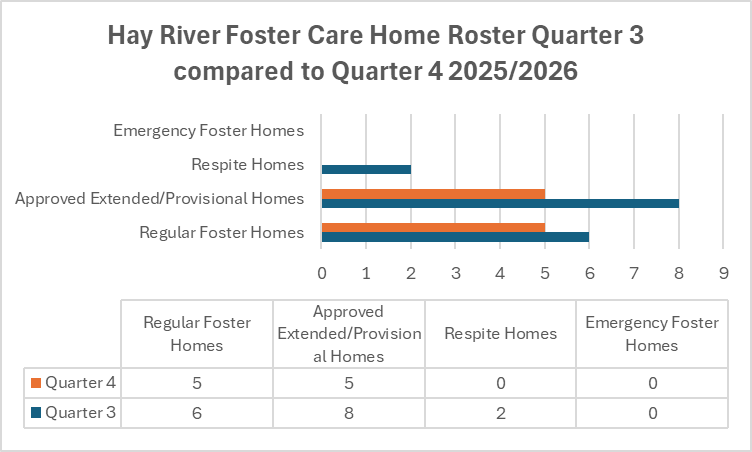
In the third quarter of 2025-26 there were six regular foster homes, eight extended family or provisional homes and two respite homes available, the health authority said. By the end of the fourth quarter, those figures had fallen to five regular foster homes, five extended family or provisional homes and no respite homes.
Advertisement.
Advertisement.
The health authority attributed the increase in children entering care to a combination of social issues affecting the community, including substance misuse, domestic violence and unsafe housing conditions.
The authority said an increase in crisis interventions linked to the drug crisis had contributed to more children coming into care.
Now, the authority is actively looking for emergency foster homes to help meet demand.
In recent months, the health authority spokesperson stated in an email, staff had “responded to multiple complex youth placements originating from outside the region.”
Advertisement.
Advertisement.
“These situations required significant after-hours responses, emergency travel arrangements, placement searches, crisis intervention, court involvement, and coordination across multiple jurisdictions,” the spokesperson wrote.
“Front-line staff and supervisors worked tirelessly to ensure youth safety and continuity of care; however, these cases also exposed challenges related to communication, information sharing, transition planning, and coordination between regions.”
The health authority said the rising number of children in care has placed growing strain on both foster families and staff, while efforts to recruit new foster homes have so far had limited success and current foster families require additional support.
In response, the authority said it had restructured one position to focus entirely on supporting and overseeing foster homes. A review of compensation for foster families was also undertaken.
To see any significant change, the authority stated, a continued response “at all levels of the community is critical.”
“Helpful options include becoming an emergency home or respite home, donating your time to take a child out from a family that’s struggling for a few hours. If possible, volunteer for an hour a week in a youth program,” the email continued.
“Continued structured supports and training for families along with increased recruitment strategies will help. Most importantly, there needs to be a return to ‘communities caring’ for children, Elders, the most vulnerable.
“There is a need for families rallying around those members who needed added support to seek help to deal with trauma and the legacies of colonization and residential schools.”
Advertisement.
Advertisement.
Jo-Anne Henderson-White, director of child, family and community wellness, said the shortage of regular, extended, and emergency foster homes has left a small group of caregivers supporting a growing number of children in care, which has increased pressure on both families and front-line staff.
During a Hay River council meeting last week, Henderson-White said improving community understanding and involvement will be important in addressing the ongoing strain on the system.
“We have 42 kids in care right now, with about 10 colleagues, and so our caregivers are burned out. They need support,” said Skye Boucher, a foster case coordinator.
“There’s only one of me in this role, and so I really do lean on the Foster Family Coalition in Yellowknife – but they’re in Yellowknife, there’s only a certain amount of things that they can provide from afar.”
Some councillors suggested holding public information sessions to explain what is required to become a foster caregiver, while increasing awareness of financial and practical supports available.
Others raised the idea of expanding community-based involvement beyond full foster care placements, such as short-term respite care.
