


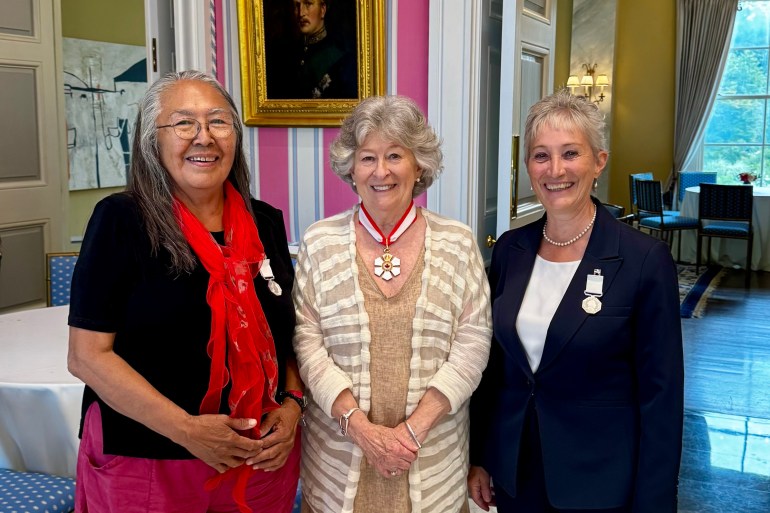
Alestine Andre and Ingrid Kritsch have received Polar Medals from the governor general for their work documenting Gwich’in culture.
The two received their medals from Governor General Louise Arbour at a June 25 ceremony in Ottawa.
Andre was recognized for her “lifelong dedication to documenting, preserving and revitalizing Gwich’in traditional knowledge, oral history and land-based practices.”
Kritsch, who worked with Andre as the executive director of the Gwich’in Social and Cultural Institute formed in the 1990s, was recognized for collaborating with Indigenous communities “in ways that honoured and amplified their leadership.”
Polar Medals are awarded by Canada to people who provide outstanding service in support of scientific research or polar exploration.
Advertisement.
Advertisement.
Together, Andre and Kritsch spent years with Gwich’in Elders working to understand and document their language and the place names they used.
Today, that work can be found in the likes of the Gwich’in Place Names Atlas, an online resource that sets out place names as recorded by more than 70 Gwich’in Elders and land users over a 20-year period.
Among all the projects she worked on as an anthropologist and at the institute, Andre said the place names work stood out for her.
“When I’m listening to old recordings and people mention the names of the places on the land, in my head I know where they’re talking about. That’s the best gift that was given to me by our Elders,” she told Cabin Radio.
Advertisement.
Advertisement.
Kritsch described carrying a “large rug” of a map, 1:50,000 scale, to Tsiigehtchic in the early 1990s to help document place names.
“We put it outside so her father could see it in the light and then we could record the names of the places as he was pointing them out on this map,” she said.
“Alestine was sitting at the edge of the map and asking her dad questions, and then I was sitting right on the map because I wanted to make sure I heard and understood where he was pointing and what he was pointing out.
“All of a sudden he turns to me and he says, ‘You’re sitting on my trap line.’ And he starts to laugh. It brought home that this map was more than just a map, this was his land. That gave me a different view.”

Andre, whose family lived at a camp along the Mackenzie River, completed an anthropology degree at the University of Victoria before beginning her work.
Now, she holds Zoom calls three times a week with relatives to maintain her language, a practice they began during the Covid-19 pandemic.
“We’re all enjoying and having fun relearning – but also using – the language that we heard from our Elders when we were growing up,” she said.
Kritsch described pride in work on Gwich’in place names that literally “changed the map,” with hundreds of names since officially recognized. Other projects included recording Gwich’in plant knowledge and traditional clothing, she said.
The Polar Medal is “to acknowledge everyone that was involved in the work over the years, and we’re very grateful and thankful that the work the Elders did with us has been recognized in this way,” Kritsch said.
