


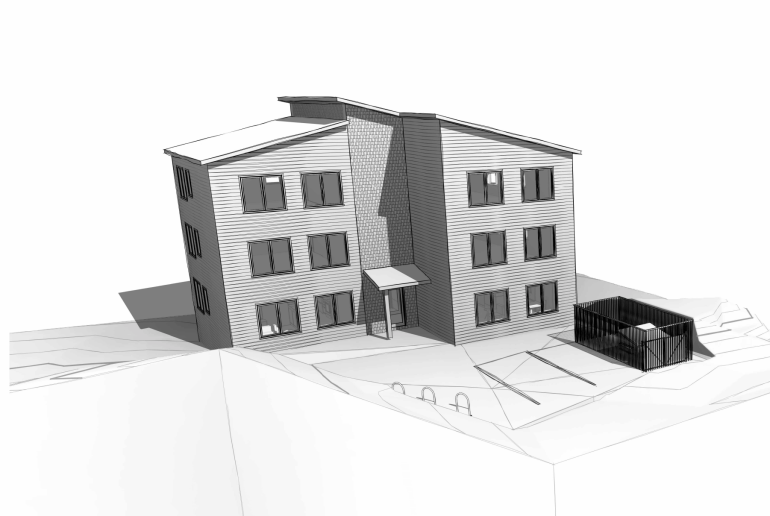
A six-unit housing block can go ahead on Findlay Point after Yellowknife’s development appeal board overturned the city’s refusal to issue a permit.
Developer Edwin Shu proposed the three-storey building for 2 Findlay Point, a cul-de-sac at the top of the Niven subdivision. The city refused a development permit on June 15 and Shu appealed days later.
In a decision issued this week, following a July 16 hearing, the board reversed the refusal and approved the project “in substantially the final form” Shu submitted.
The proposal required only one exemption from the city’s zoning bylaw: permission for one corner of the building to encroach a little over half a metre into the rear yard setback. The board said that arose from the lot’s irregular shape and topography and was “very minor in nature.”
A larger concern expressed by nearby residents had related to parking. The project proposed dropping the usual system of one parking space per unit in favour of offering a car-share vehicle. City planners thought that might “result in increased reliance on on-street parking” and cause congestion.
Advertisement.
Advertisement.
The board found the car-share plan met the bylaw’s requirements, noting city council “expressly contemplated and authorized” car-share arrangements when it adopted the bylaw.
Development officer Bassel Sleem had told the board the refusal was not about non-compliance. Instead, he said, the cumulative effect of development on the cul-de-sac – which he believed had reached its capacity – would have an overall negative impact on the surrounding community.
Some residents agreed. According to board documentation, Scott Robertson told the hearing the concentration of multi-unit buildings on Findlay Point exceeded that of comparable cul-de-sacs elsewhere in Niven, and said the parking proposed would not meet demand. In a written submission, Ryan Plustwa said densification had already created safety issues, arguing a duplex should be the most the lot accommodates.
The board accepted the development would increase density on Findlay Point and called residents’ concerns “sincerely held and understandable.” But it said it could find no policy in the community plan or zoning bylaw requiring cumulative effects to be considered, nor any thresholds limiting them.
Advertisement.
Advertisement.
“Public concern, while relevant, is not by itself determinative,” the board wrote. “The evidence did not establish that the proposed development would generate impacts beyond those reasonably contemplated by those planning instruments.”
Concluding the development otherwise complied with the bylaw – which neither side disputed – the board found the permit “ought to have been approved.”
The decision is final and not subject to appeal.
