

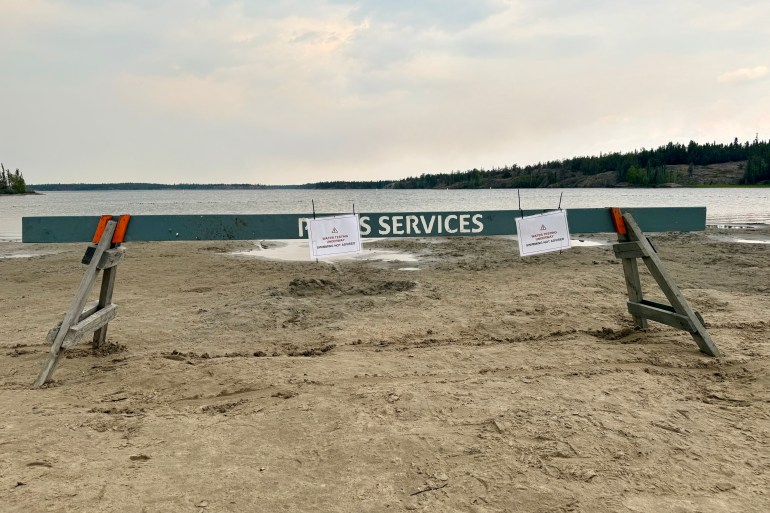
The NWT government has reopened a Yellowknife beach after E coli warnings regarding the water turned out to have been based on an apparent sampling error.
Signs warning people not to go swimming were placed along the beach at Fred Henne Territorial Park on Thursday.
The GNWT previously said routine monthly monitoring had recorded high levels of E coli and other bacteria. In a Friday email to Cabin Radio, the Department of Industry, Tourism and Investment – which is responsible for territorial parks – said samples were taken on June 25 and the results came back on Thursday, necessitating immediate action.
Health Canada says E coli levels of 235 colony-forming units per 100 ml are the level at which action should be taken. The GNWT told Cabin Radio its June 25 samples returned an estimate of 1,050 to 1,410 per 100 ml.
“Due to these results we have ordered further tests, with future results coming in within 24 hours while the issue persists, and will continue to do so every two-three days,” an ITI spokesperson said by email on Friday evening.
Advertisement.
Advertisement.
By Saturday evening, multiple sets of further test results had arrived, from which the department appeared to have concluded the sample that suggested elevated E coli levels was an error.
“Swimming restrictions at the main beach area of Fred Henne Territorial Park are now lifted. Follow-up testing indicated safe levels of bacteria,” read a statement issued shortly before 9:30pm.
Samples from July 2 and July 3 had come down from 1,050-1,410 per 100 ml to just 3.1 and 4.1 respectively, the territory said.
“Sampling and testing will continue daily for one week as we continue monitoring levels. The GNWT’s Chief Environmental Health Officer provided a recommendation today that the beach could be reopened.
“We thank the public for the patience and understanding as we carried out the routine procedures related to water testing.”
